You have no items in your shopping cart.
Blog / Urban Farming with Hydroponics: Grow Fresh Food Without Soil
Urban Farming with Hydroponics: Grow Fresh Food Without Soil
Summary
Hydroponics grows plants in nutrient-rich water instead of soil, so it needs no arable land and recirculates water rather than draining it. With Singapore importing over 90% of its food, it is a genuinely useful skill — and one you can learn in a day with WSQ funding. This is how it works, and what it looks like at commercial scale.
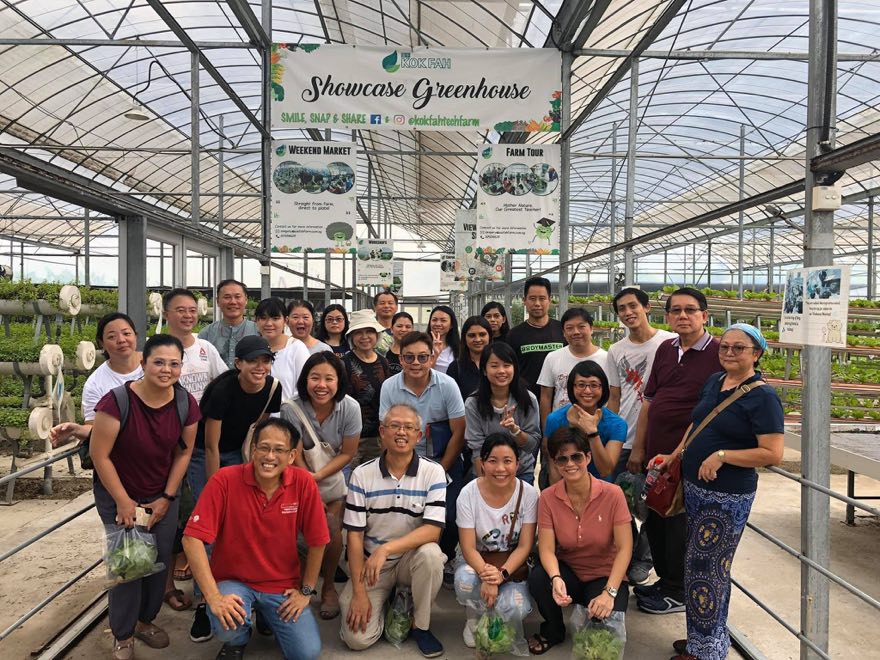
On 24 November 2019 we took a class through a working Singapore hydroponics farm: the theory in the morning, the greenhouse in the afternoon, and a hydroponics kit to take home. This guide follows what they saw, because seeing production scale is what makes the principles stick.
Why hydroponics matters in land-scarce Singapore
Singapore imports more than 90% of its food, and less than 1% of its land is set aside for agriculture. Those two facts are why growing without soil stopped being a hobbyist curiosity here and became a national capability question.
Hydroponics fits the constraint because it does not need farmland — it needs a surface. A rooftop, a car-park deck, a warehouse, a spare room. And because the solution recirculates rather than draining away, it uses a fraction of the water that field farming loses to the ground and the air.
What hydroponics actually is
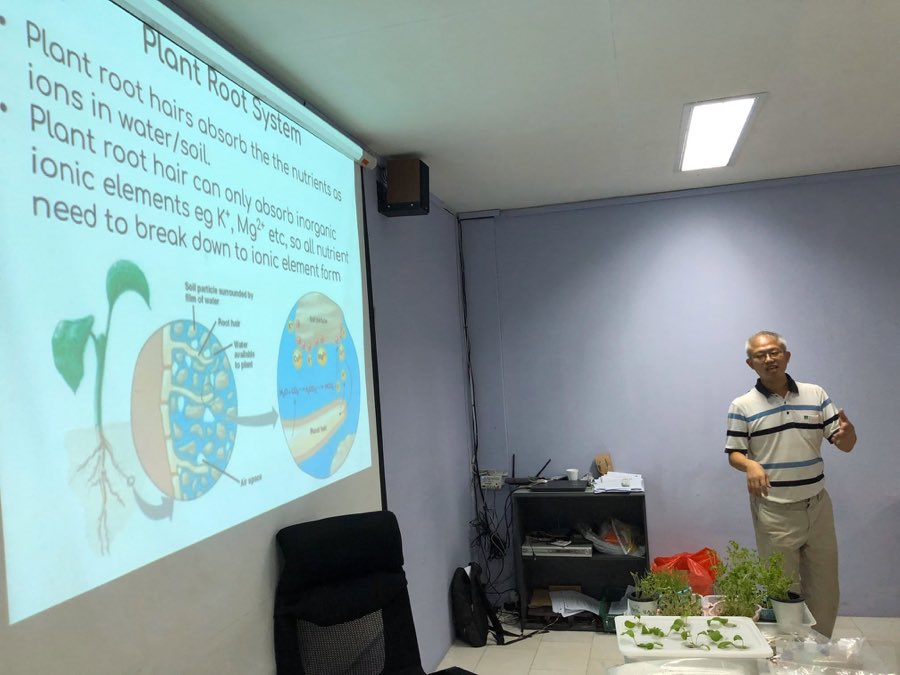
That slide is the whole concept in one line. Root hairs absorb nutrients as ions dissolved in water. In soil, minerals must first break down into that ionic form before a plant can take them up. Hydroponics simply skips the intermediary and delivers the ions already dissolved.
Plants take three elements from air and water — carbon, hydrogen and oxygen — and thirteen more as mineral nutrients. In a field those thirteen come from the soil; in hydroponics they come from the nutrient solution. The plant cannot tell the difference, which is why hydroponic produce is nutritionally comparable to soil-grown, and sometimes better, because the grower controls the recipe precisely.
The beginner-friendly systems all solve the same four problems — hold the plant up, feed the roots, keep them oxygenated, keep light off the water:
- Deep water culture (DWC) — roots hang in oxygenated nutrient solution. The simplest to start with; a jar on a windowsill is already one.
- Nutrient film technique (NFT) — a thin film of solution flows down tilted channels past bare roots and recirculates.
- Kratky method — passive, no pump; the solution level drops as the plant drinks, leaving an air gap for the roots.
- Ebb and flow — the grow bed floods and drains on a timer, so roots alternate between solution and air.
What it looks like at commercial scale
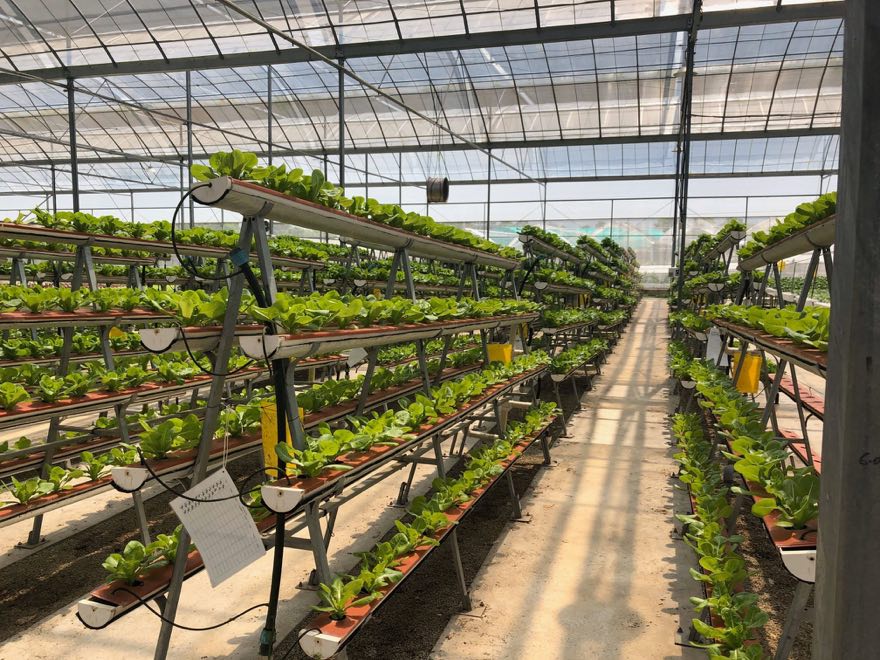
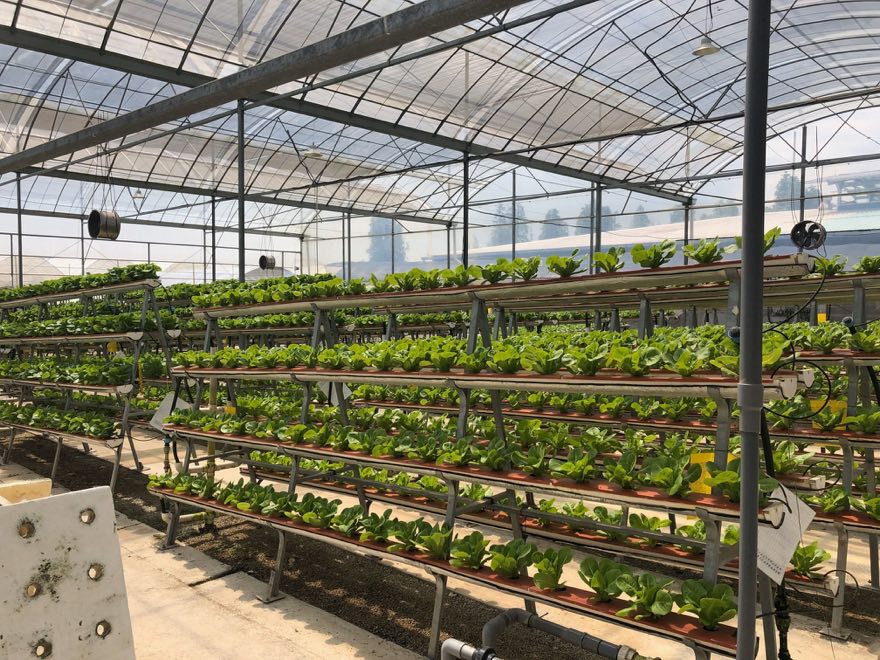
This is NFT answering the land problem directly. Each sloped channel carries a thin film of nutrient solution past the roots; stacking them into an A-frame means one square metre of floor supports several square metres of growing area. That is the whole vertical-farming idea in its simplest mechanical form — no LEDs or software required, just geometry.
Three details from these racks are worth copying at home:
- The channels are tilted. A slight, consistent gradient keeps the film moving. Too flat and it pools and goes short of oxygen; too steep and it runs past the roots too fast to feed them.
- The film is deliberately thin. Roots sit in a shallow stream, so the upper root mass stays in humid air. That is how NFT gets oxygen to roots without an air pump.
- Spacing is set for the mature plant, weeks before it needs it. Crowding traps humidity between leaves and invites disease.
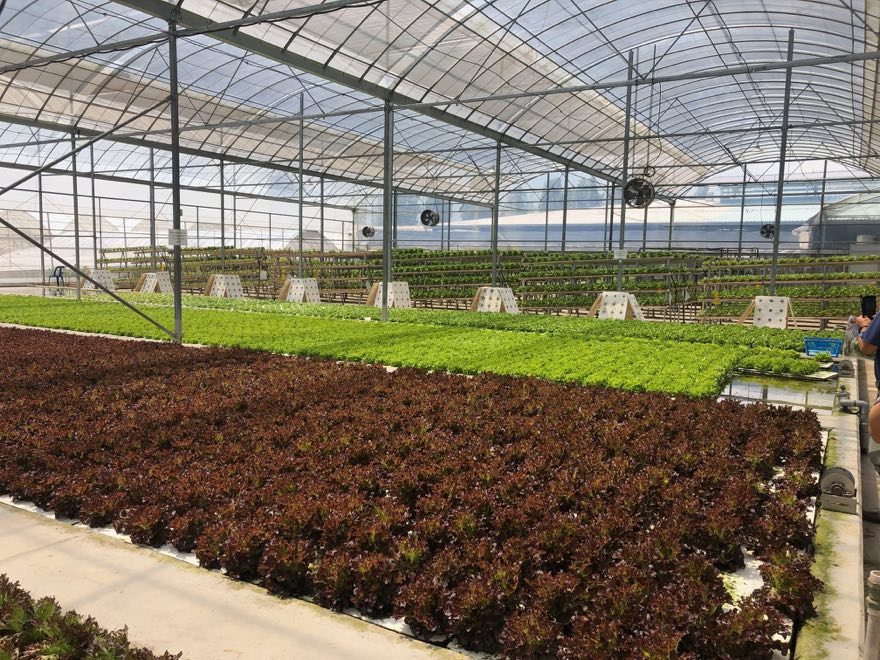
Look at how consistent the heads are. In soil, every plant negotiates with its own patch of ground, so size varies. Here every plant receives the same solution at the same concentration, and the variable that usually drives inconsistency has been removed. That predictability is what turns growing food into a business you can plan around.
It is not only leafy greens
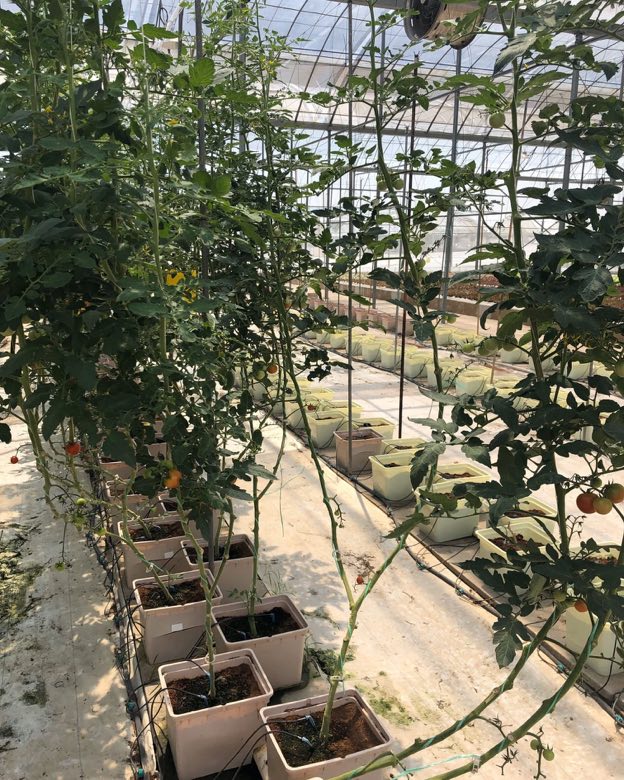
Leafy greens dominate hydroponics because they are fast, shallow-rooted and forgiving. But fruiting crops work too, with more effort: each vine here has its own container and drip line, is trained vertically on a string to save floor space, and needs a nutrient recipe that shifts as it moves from leafy growth into fruiting.
| Crop | Time to harvest |
|---|---|
| Lettuce, bok choy, kai lan | 3 to 5 weeks |
| Basil, mint, coriander | 3 to 6 weeks |
| Kale, spinach, chye sim | 4 to 6 weeks |
| Cherry tomatoes, chilli | 8 to 12 weeks |
Start with the top three rows. The bottom row is a project for after you have kept a system stable through a couple of full crop cycles.
What you actually need to start
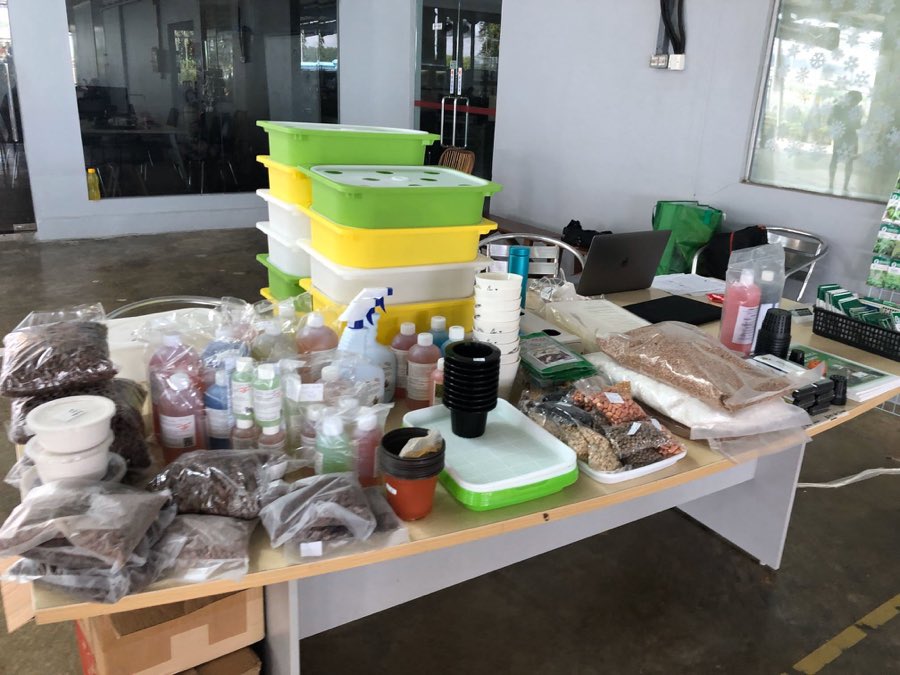
That table is the honest answer to "what does it cost to begin". A grow tub with a lid, net pots, a growing medium (clay pebbles, rockwool or coco peat), nutrient A and B concentrates, and seed. Nothing exotic and nothing expensive — the Singapore Food Agency puts a complete beginner kit at under $100.
The two items worth spending real attention on are not on that table in any obvious way: a TDS/EC meter and a pH meter. EC tells you how much nutrient is dissolved — how strong the feed is. pH decides whether the plant can absorb it; most crops want roughly 5.5 to 6.5, and outside that band nutrients are present in the tank but chemically locked away. Without meters you are growing blind, and a plant can starve in a full reservoir.
Who this is for
- Home growers who want fresh, pesticide-light greens year-round in a flat
- Aspiring urban farmers and agripreneurs testing whether the business is for them
- F&B owners who want their own herbs and microgreens
- Educators, community-garden leaders and sustainability advocates
The course, and what it costs
WSQ - Basic Urban Farming with Hydroponics (course code TGS-2025053916) is a 1-day, 8-hour class at Beginner level with a 1-hour assessment, held at MEOD Farm, 13 Neo Tiew Harvest Lane. It maps to the SkillsFuture Skills Framework TSC Urban Farming Implementation and Management Control (AGR-FOP-2002-1.1), with two learning outcomes:
- Perform farming activities and equipment operations according to standard operating procedures
- Execute farming operations work in accordance with regulations, WSH practices and housekeeping rules
The day covers hydroponic system types, growing media, plant nutrition and nutrient solutions, pH and EC monitoring, indoor farming conditions including lighting and humidity, Singapore's urban farming regulations, good agriculture practices and workplace safety — plus hands-on practice with a hydroponics kit and a guided tour of a commercial hydroponics farm.
The full fee is $350 before GST. With WSQ funding:
| Who you are | Nett fee | Funding |
|---|---|---|
| Singapore Citizen / PR, aged 21 and above | $206.50 | 50% course-fee funding |
| Singapore Citizen aged 40 and above (MCES), or SME-sponsored | $136.50 | 70% course-fee funding |
GST of $31.50 (9%) applies to the full course fee. Funding is valid from 24 March 2025 to 23 March 2027. Eligible Singapore Citizens can apply SkillsFuture Credit and PSEA against the nett fee, NTUC members may claim UTAP, and employers can tap SFEC with Absentee Payroll support. Completion — at least 75% attendance plus a pass in the assessment — earns a Certificate of Achievement from Tertiary Infotech Academy and an OpenCert (Statement of Achievement) from SkillsFuture Singapore.
Check the next class date and funding eligibility →
Frequently asked questions
Do I need a garden or a balcony?
No. A shelf with an LED grow light and a small reservoir will keep a household in leafy greens and herbs, and it fits in a kitchen corner, spare room or office pantry. Compact indoor setups are covered in class. For larger balcony or corridor systems, check your town council rules first — the course covers Singapore's urban farming regulations.
Is hydroponic produce full of chemicals, or less nutritious?
Neither. The nutrients are the same thirteen mineral elements a plant would take up from soil, delivered dissolved in water instead. The Singapore Food Agency addresses this myth directly: concentrations are minimal, the compounds are absorbed and converted by the plant, and nutrient content is on par with — sometimes higher than — soil-grown equivalents, because the grower controls the recipe.
Can I use SkillsFuture Credit for this course?
Yes. The WSQ subsidy applies first, bringing the $350 fee to $206.50, or $136.50 for Singapore Citizens aged 40 and above under MCES. Eligible Singapore Citizens can then use SkillsFuture Credit against the nett amount, and PSEA funds may also be applied. Note that the $4,000 Additional SkillsFuture Credit (Mid-Career Support) cannot be used for this course.
Is hydroponics hard to maintain?
Day to day it takes minutes — top up the reservoir, check the meters, look at the roots. The skill is in the setup and in reading what a drifting number means, which is exactly what the course drills. Small volumes swing faster than large ones, so a jar needs more frequent attention than a tub.
Do I need any farming experience to join?
None. The course is Beginner level and most participants have never grown anything before. Hydroponics rewards careful measurement more than it rewards a green thumb, which is good news if you have killed houseplants before.
Does the course include a farm visit?
Yes. The one-day course includes a guided tour of a commercial hydroponics farm alongside the classroom theory and hands-on kit practice, and is held at MEOD Farm so the working-farm context is built in.
What to do next
- Decide what you want to grow first — salad greens and herbs are the easiest wins, and fast enough to teach you something within a month.
- Join the next WSQ - Basic Urban Farming with Hydroponics class — from $136.50 nett for eligible Singapore Citizens aged 40 and above.
- Buy the two meters before you buy anything else fancy, and keep a log of pH, EC and what you changed.
More from this course: hydroponics in a jam jar, building a deep water culture kit step by step, inside a working hydroponic farm, growing melons hydroponically, and why hydroponics matters for Singapore.