You have no items in your shopping cart.

Blog / Can You Grow Melons Hydroponically in Singapore? Our 11 October 2025 Class Says Yes
Can You Grow Melons Hydroponically in Singapore? Our 11 October 2025 Class Says Yes
Ask most people what hydroponics grows and they will say lettuce. They are not wrong — leafy greens are the easiest, fastest and most forgiving crop in a soil-less system, which is why every beginner starts there and why most commercial vertical farms are stacked with them.
But it is a ceiling people impose on the technology rather than one the technology has. Hydroponics grows fruit. Including, in Singapore, melons.
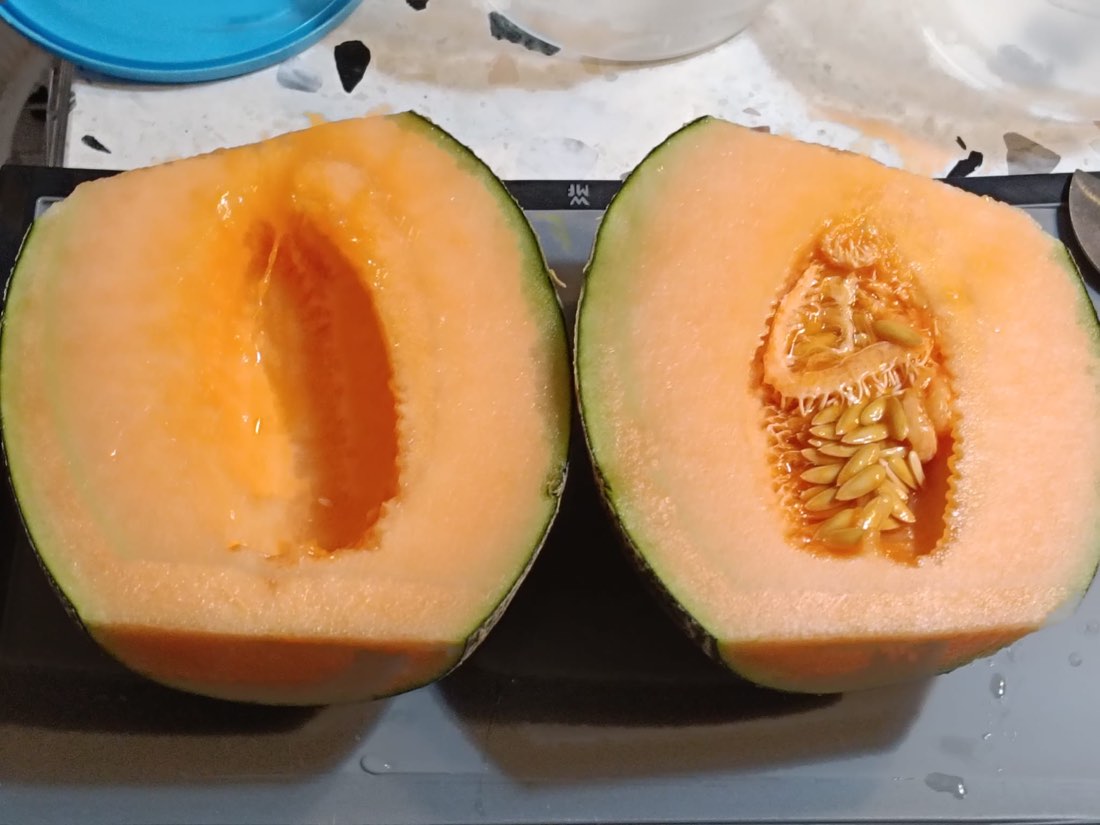
That is a rockmelon. It was grown in a nutrient solution, not soil, in a country with no melon season and effectively no farmland. We showed it in our WSQ - Basic Urban Farming with Hydroponics class on 11 October 2025 for exactly that reason: it resets what people think the method is for.
Why melons are the interesting case
A lettuce is a leaf. You give it light, water, nutrients and a few weeks, and you harvest the whole plant. A melon is a fruit, which means the plant has to complete a much longer and more demanding programme: grow a vine, flower, get pollinated, set fruit, and then pump weeks of sugar into it.
Each of those stages asks something a leafy green never does:
- The nutrient recipe has to change with the stage. Vegetative growth wants nitrogen. Fruiting wants relatively more potassium and phosphorus. A single fixed formula that grows beautiful leaves will give you a vine with disappointing fruit.
- EC generally rises as the fruit develops. Growers commonly push conductivity higher during fruiting, which is one of the levers behind sweetness — and precisely why the meter is not optional.
- Pollination will not happen by itself indoors. No wind, no bees. Melon flowers get pollinated by hand, usually with a small brush, and the timing matters because the female flower is receptive only briefly.
- The fruit needs physical support. A developing melon is heavy enough to tear itself off the vine. Growers sling each fruit in a net.
- You must thin the fruit. A vine that sets six melons ripens six mediocre ones. Cut it back to one or two and the plant concentrates its sugar where you want it.
- It takes months, not weeks. Every mistake has a long feedback loop, which is why people practise on lettuce first.
The reward for that work is a fruit grown with no soil, no field, no season and no pesticide regime, in a system whose conditions you set. The Singapore Food Agency makes the general version of this point: control over temperature, humidity, airflow and CO2 lets a grower deliberately produce a desired taste and texture profile. With a melon, that control shows up directly as sweetness.
Everything starts the same way
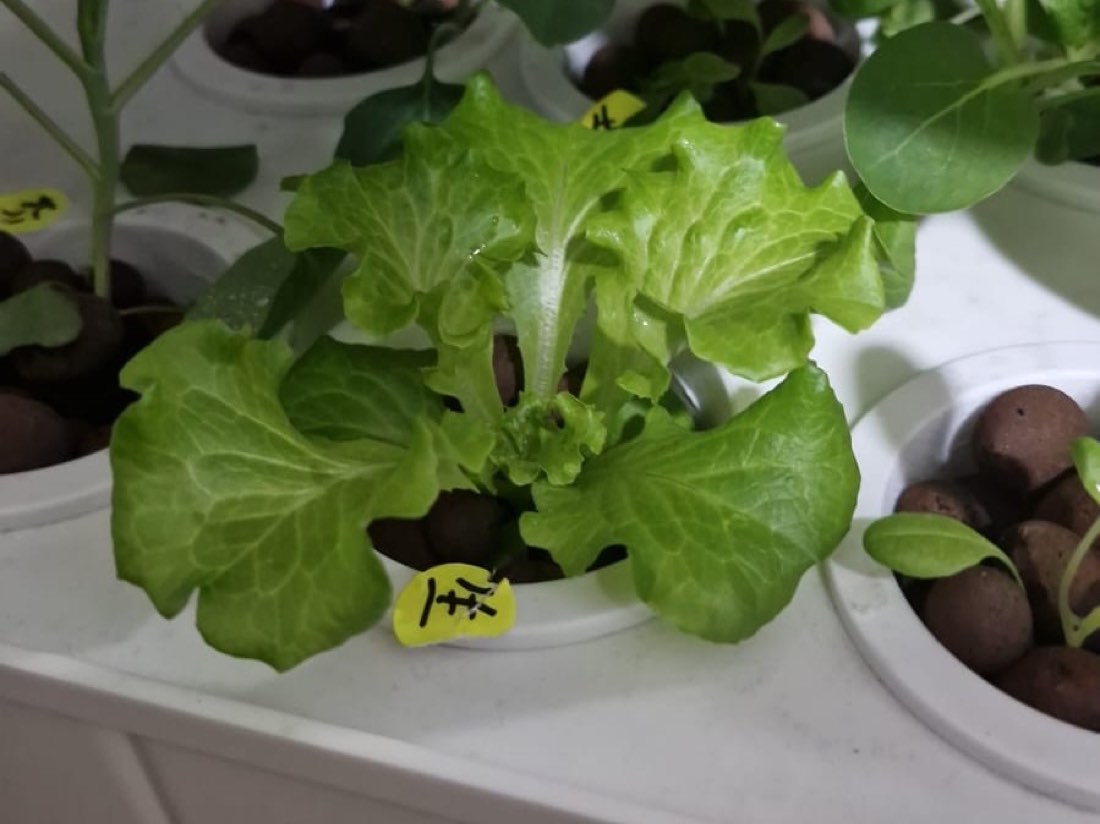
This is where a melon and a lettuce are indistinguishable: a seedling in a net pot of clay pebbles, roots reaching for the solution, under a light. The clay pebbles hold no nutrition at all — they exist to anchor the plant and hold air around the roots, because roots need oxygen as much as they need water. Drowned roots rot; that is the most common way a beginner's system dies.
The hand-written labels are not decoration either. When several varieties share a tray at the same stage, the label is the only thing that tells you which is which — and knowing which cultivar is in front of you is the difference between a record and a guess.
The same principles, at commercial scale
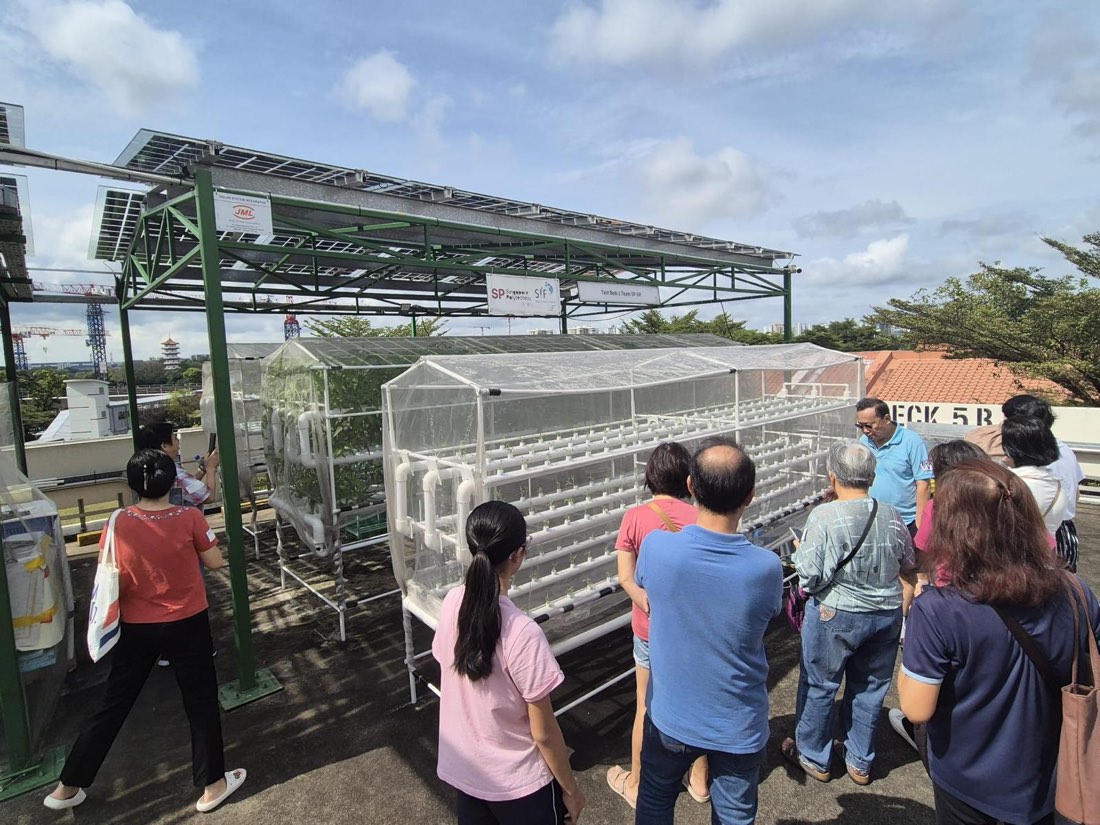
This is the argument for hydroponics in Singapore, in one photograph: a working farm on a rooftop deck, growing food on a surface that already existed and produces nothing otherwise. The white PVC channels are nutrient film technique — a thin, continuous film of nutrient solution flowing past bare roots, recirculating back to the reservoir rather than draining away. The panels overhead run the pumps. The netting keeps pests out without pesticide.
Nothing there is conceptually different from the kit on the classroom bench. Same solution, same measurements, same principles — larger channels and a pump with more work to do. That is the point of a learning journey: it makes the jump from tabletop to production feel like a change of scale rather than a change of subject.
Singapore is full of this pattern. ComCrop grows on a Woodlands rooftop. Sustenir grows strawberries and kale indoors in a fully controlled climate. An NUS spin-off, Singrow, has worked on cultivars bred for tropical controlled-environment growing. And in 2025 Greenphyto opened a vertical farm with 23-metre growing chambers, reported as the tallest in the world. None of it needs farmland.
What the class covers
WSQ - Basic Urban Farming with Hydroponics (course code TGS-2025053916) is one day, 8 hours, Beginner level, with a 1-hour assessment, held at MEOD Farm, 13 Neo Tiew Harvest Lane. It maps to the SkillsFuture Skills Framework TSC Urban Farming Implementation and Management Control (AGR-FOP-2002-1.1), with two learning outcomes:
- Perform farming activities and equipment operations according to standard operating procedures
- Execute farming operations work in accordance with regulations, WSH practices and housekeeping rules
Across the day you cover hydroponic system types (deep water culture, NFT, wick, ebb and flow, drip), growing media, plant nutrition and nutrient solutions, pH and EC monitoring, indoor farming conditions including lighting and humidity, Singapore's urban farming regulations, good agriculture practices and workplace safety — plus a guided tour of a commercial hydroponics farm and hands-on practice with a hydroponics kit.
Melons are not a syllabus item. What the course gives you is the foundation that makes attempting one sensible: if you can hold a stable pH and EC, keep roots oxygenated and read what a plant is telling you, adapting to a fruiting crop is a matter of adjusting the recipe and adding hand pollination, netting and thinning. Try it without that foundation and you will lose several months finding out.
What it costs
The full fee is $350 before GST. With WSQ funding:
| Who you are | Nett fee | Funding |
|---|---|---|
| Singapore Citizen / PR, aged 21 and above | $206.50 | 50% course-fee funding |
| Singapore Citizen aged 40 and above (MCES), or SME-sponsored | $136.50 | 70% course-fee funding |
GST of $31.50 (9%) applies to the full course fee. Funding is valid from 24 March 2025 to 23 March 2027. Eligible Singapore Citizens can apply SkillsFuture Credit and PSEA against the nett fee, NTUC members may claim UTAP, and employers can tap SFEC with Absentee Payroll support. Completion — 75% attendance plus a pass — earns a Certificate of Achievement from Tertiary Infotech Academy and an OpenCert from SkillsFuture Singapore.
Check the next class date and funding eligibility →
Frequently asked questions
Does the course teach me to grow melons specifically?
No — it teaches the fundamentals that fruiting crops are built on: system types, nutrient solutions, pH and EC control, growing media, and indoor environment management. Melons are shown as proof of what the method can do. Growing one is a project you take on afterwards, with the measurement discipline the course gives you.
What is realistically the easiest thing to grow first?
Leafy greens and herbs — lettuce, bok choy, kailan, basil, mint. They are fast, forgiving, and harvestable in weeks, so you get through several complete cycles (and several mistakes) in the time a single melon would take.
Why do hydroponic plants sit in clay pebbles if there is no nutrition in them?
The medium's job is structural, not nutritional. Clay pebbles anchor the plant and hold air pockets around the roots, which need oxygen as well as water — permanently submerged roots rot. All the nutrition arrives dissolved in the solution. Rockwool and coco peat do the same job with different water-retention behaviour.
Do I need a big space or a rooftop?
No. A shelf with an LED grow light and a small reservoir is enough for a household supply of greens. The rooftop farms show what the same principles look like scaled up — useful if you are thinking commercially, but not a prerequisite for starting.
Is this course funded, and how long is the funding valid?
Yes. WSQ funding brings the $350 fee to $206.50 for Singapore Citizens and PRs aged 21 and above, or $136.50 for Singapore Citizens aged 40 and above under MCES. SkillsFuture Credit, PSEA and UTAP can be applied on top. Funding runs from 24 March 2025 to 23 March 2027.
Where to go next
The melon is a demonstration, not a target. The real point is that in a country importing over 90% of its food on almost no farmland, growing anything at all without soil is a capability worth having — and the people who have it started by learning to mix a solution and read a meter.
- Start with leafy greens and run at least two full crop cycles before attempting fruit.
- Join the next WSQ - Basic Urban Farming with Hydroponics class — from $136.50 nett for eligible Singapore Citizens aged 40 and above.
- Keep a log of pH, EC and what you changed. It is the only way the long feedback loop of a fruiting crop becomes learnable.
New to all this? Start with our companion post on why hydroponics matters for Singapore, from the 6 June 2026 run of the same course.