You have no items in your shopping cart.

Blog / Hydroponics in a Jam Jar: What Our 5 July 2025 Learners Grew on a Windowsill
Hydroponics in a Jam Jar: What Our 5 July 2025 Learners Grew on a Windowsill
Most people meet hydroponics as a photograph of a warehouse: racks of lettuce under purple light, pumps, sensors, a control panel. It is an impressive image and a discouraging one, because it makes the method look like something you need capital to attempt.
So we start our learners somewhere else entirely. A glass jar. Tap water. One seedling.
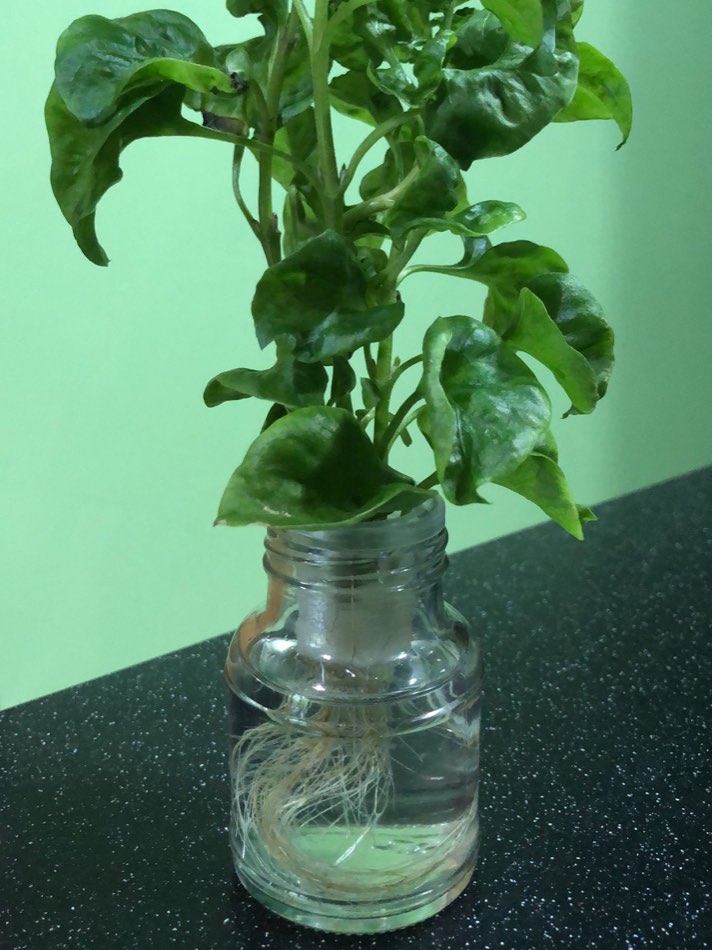
That plant was grown by learners from our WSQ - Basic Urban Farming with Hydroponics class on 5 July 2025. It has no soil. It never had soil. Everything it is made of came out of that water and the air, and it is thriving in a container you would otherwise put in the recycling.
Why a jar is a real hydroponic system
This is not a simplified demonstration of hydroponics. It is hydroponics, in its oldest and most stripped-down form — what growers call deep water culture. The definition of the method is growing plants in a nutrient solution instead of soil, and a jar satisfies it completely.
Everything else you see in a commercial farm exists to do one of four things at scale, all of which a jar handles by hand:
- Hold the plant up. A jar's neck does this for free. Larger systems need net pots and a lid.
- Deliver nutrients to the roots. In a jar, the roots simply sit in the solution. Bigger systems pump it past them.
- Get oxygen to the roots. A jar relies on the surface of the water and on the top of the root mass staying above the waterline. Larger tanks add an air pump.
- Keep light off the water. A jar needs you to place it thoughtfully or wrap it. A tank has a lid.
Understand it in a jar and every larger system becomes recognisable, because the extra hardware is answering questions you have already met.
The roots are the lesson
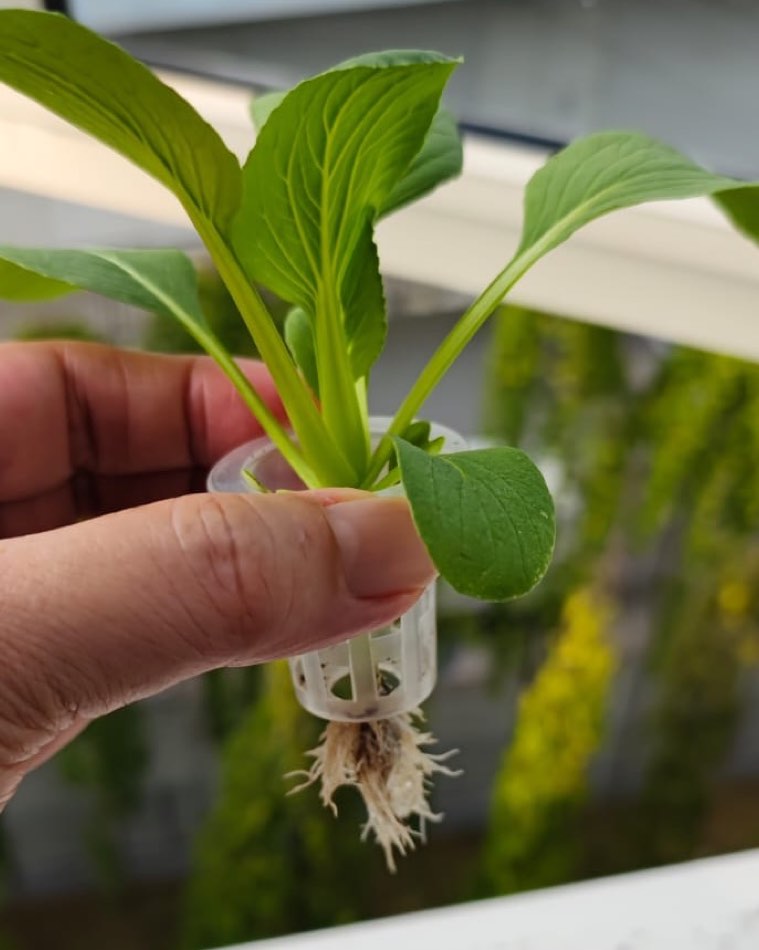
Lift a plant out mid-grow and the mechanism stops being theoretical. Those white roots have grown through the slots in the net pot and down into the water, and their appearance is diagnostic information you can read at a glance:
- White or cream and firm means healthy and well-oxygenated. That is what you want, and what the photo shows.
- Brown, slimy or smelling sour means root rot — almost always too little oxygen, from a plant submerged too deep or water left too long unchanged.
- Sparse and short after several weeks usually means the roots never reached the water, or the solution is too weak.
In soil this information is buried, and by the time trouble shows in the leaves you have lost weeks. In water you can see the problem developing. That visibility is one of the genuine teaching advantages of hydroponics, and it is why a transparent jar beats an opaque tub for a first attempt even though the tub is better horticulture.
How to set one up
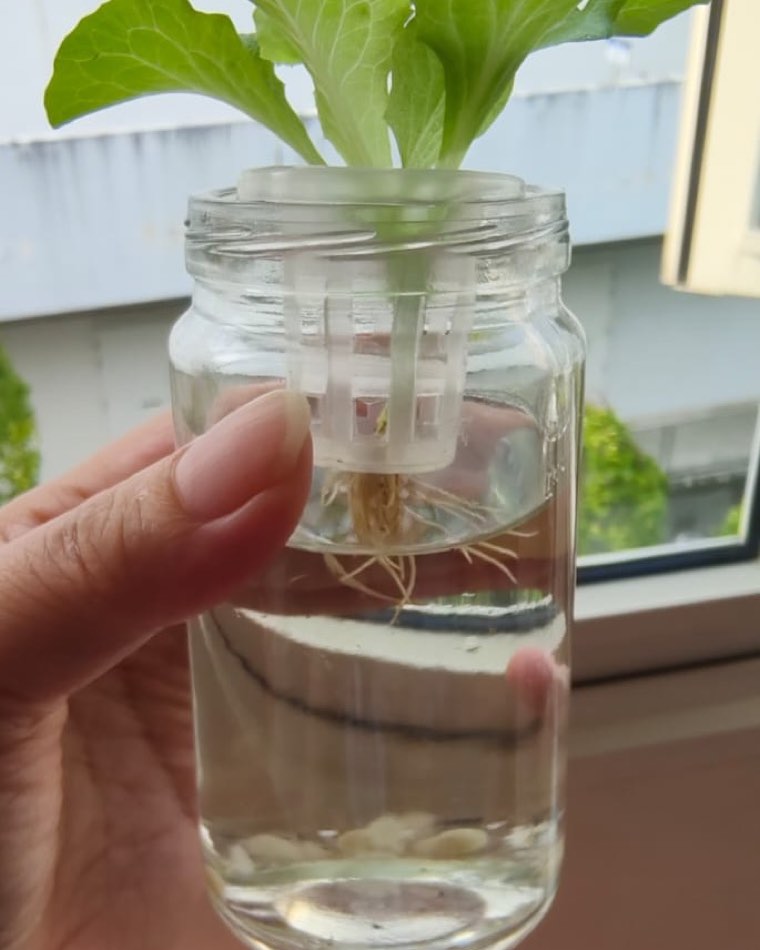
The build is genuinely this short:
- Germinate a seed in a grow sponge until it has roots and a couple of true leaves. Soak the sponge until saturated through, then squeeze out the excess — roots need air as much as water.
- Sit the sponge in a net pot, seated flush with the base so there is no air gap underneath.
- Fill a clean jar with water and nutrient solution mixed to the strength on the bottle.
- Rest the net pot in the mouth of the jar so the bottom of the pot just touches the surface. The roots grow down to meet the water; the top of the root zone stays in air.
- Put it somewhere bright — a windowsill with several hours of light is enough for leafy greens in Singapore.
Then the maintenance, which is where most jar attempts actually fail:
- Top up as the level drops, and change the solution completely every week or two. Standing water goes stale and short of oxygen.
- Keep light off the water. Clear glass in bright light grows algae, which turns the water green and competes with the plant. Wrap the jar, use coloured glass, or keep the water shaded while the leaves stay lit — the tradeoff for being able to see the roots.
- Do not submerge the whole root mass. The section above the waterline is doing the breathing.
What grows well this way
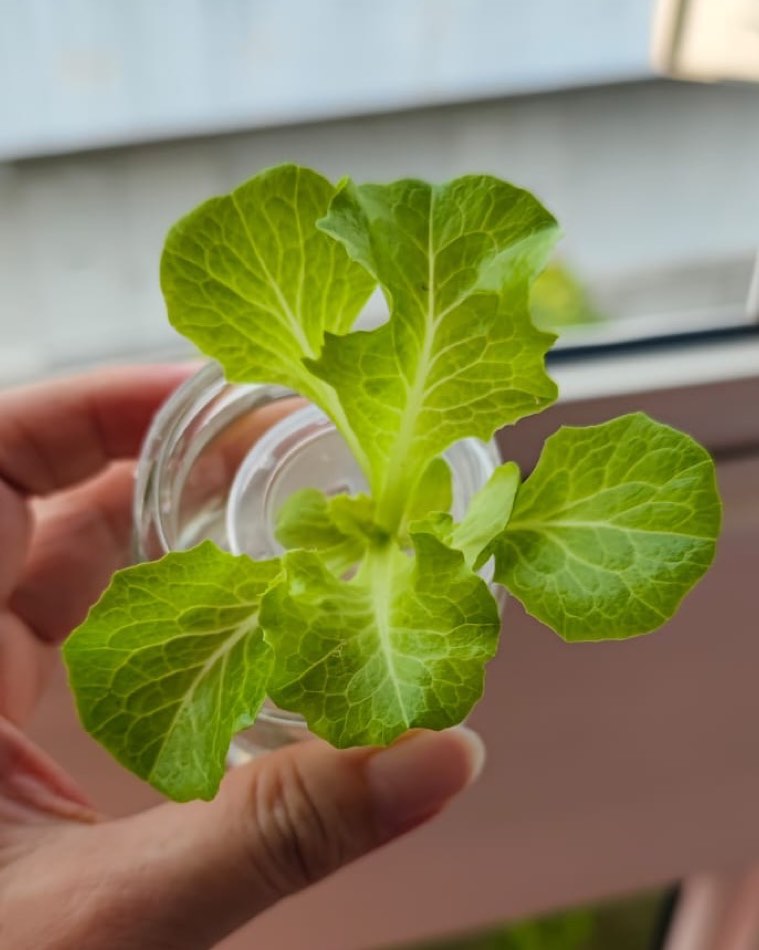
Leafy greens and herbs, essentially. Lettuce, bok choy, kailan, chye sim, basil, mint. They are shallow-rooted, they want nitrogen rather than a complicated feeding schedule, and many are harvestable in weeks. Several can be picked leaf by leaf, so one plant feeds you repeatedly instead of once.
What does not work in a jar is anything large or long. Fruiting crops such as tomatoes and melons need far more root volume, more nutrient throughput, physical support and months of attention — they are entirely possible hydroponically, just not in a jam jar. Root vegetables want depth and structure a jar cannot give.
The honest limits of the method at this scale:
- Volume. A jar holds one plant. Feeding a household is an argument for a tub with a lid and several planting sites.
- Stability. A small volume of water swings quickly in concentration and temperature. Bigger reservoirs are more forgiving precisely because they are bigger.
- Oxygen. Without an air pump you are relying on surface exchange, which puts a ceiling on how large a plant you can support.
None of that is an argument against starting here. It is the argument for starting here: a jar teaches you to read roots, mix a solution and keep water fresh, on a system where a mistake costs one plant and a fortnight.
From a jar to a system
The natural next step is the same principle with a bigger reservoir and a lid — which is exactly the kit our December class built, covered in our post on building a deep water culture system from scratch. Same four jobs, more planting sites, and a meter instead of guesswork.
Our WSQ - Basic Urban Farming with Hydroponics course (course code TGS-2025053916) is a 1-day, 8-hour class at Beginner level with a 1-hour assessment, at MEOD Farm, 13 Neo Tiew Harvest Lane, mapped to the SkillsFuture Skills Framework TSC Urban Farming Implementation and Management Control (AGR-FOP-2002-1.1). Its two learning outcomes:
- Perform farming activities and equipment operations according to standard operating procedures
- Execute farming operations work in accordance with regulations, WSH practices and housekeeping rules
The day covers hydroponic system types (deep water culture, nutrient film technique, wick, ebb and flow, drip), growing media, plant nutrition and nutrient solutions, pH and EC monitoring, indoor farming conditions including lighting and humidity, Singapore's urban farming regulations, good agriculture practices and workplace safety — plus hands-on practice with a hydroponics kit and a guided tour of a commercial hydroponics farm.
What it costs
The full fee is $350 before GST. With WSQ funding:
| Who you are | Nett fee | Funding |
|---|---|---|
| Singapore Citizen / PR, aged 21 and above | $206.50 | 50% course-fee funding |
| Singapore Citizen aged 40 and above (MCES), or SME-sponsored | $136.50 | 70% course-fee funding |
GST of $31.50 (9%) applies to the full course fee. Funding is valid from 24 March 2025 to 23 March 2027. Eligible Singapore Citizens can apply SkillsFuture Credit and PSEA against the nett fee, NTUC members may claim UTAP, and employers can tap SFEC with Absentee Payroll support. Completion — at least 75% attendance plus a pass in the assessment — earns a Certificate of Achievement from Tertiary Infotech Academy and an OpenCert (Statement of Achievement) from SkillsFuture Singapore.
Check the next class date and funding eligibility →
Frequently asked questions
Can I really grow vegetables in just a jar of water?
Yes, for leafy greens and herbs. A jar with nutrient solution and a net pot is a deep water culture system — the same method commercial farms use, without the pumps and plumbing that exist to run it at scale. You will not feed a family from one jar, but you will grow real, edible lettuce or bok choy.
Do I need plain water or nutrient solution?
Nutrient solution. Plants take carbon, hydrogen and oxygen from air and water, but the other thirteen elements they need have to be dissolved in the water — in soil they come from the soil. A cutting will survive a while in plain water on its own reserves, then stall. For actual growth you need hydroponic nutrients.
How often should I change the water?
Top up as the level drops, and replace the solution entirely every one to two weeks. Small volumes go stale and lose oxygen quickly, and as plants drink, the water leaves faster than the dissolved salts do, so the solution gradually concentrates.
My water turned green. What happened?
Algae, caused by light reaching nutrient-rich water. It is the standard tradeoff of a clear glass jar. Wrap the jar, use dark glass, or shade the water while keeping the leaves in light. It competes with your plant for nutrients, so deal with it rather than ignoring it.
Should the roots be completely underwater?
No. Roots need oxygen as well as water, and in a jar without an air pump the section of root above the waterline does the breathing. Fully submerge the root mass and you risk root rot — brown, slimy roots and a sour smell. Keep the bottom of the net pot just touching the surface and let the roots reach down.
Can I grow tomatoes or melons this way?
Not in a jar. Fruiting crops need much more root volume, nutrient throughput and physical support, plus months rather than weeks. They grow well hydroponically in a properly sized system — see our post on growing melons hydroponically — but a jam jar cannot support one.
Where to go next
If hydroponics has seemed like something requiring a warehouse and a budget, the jar is the correction. One container, one seedling, one nutrient bottle, and a windowsill.
- Start one jar this week with a lettuce or bok choy seedling. Watch the roots, not just the leaves.
- Join the next WSQ - Basic Urban Farming with Hydroponics class — from $136.50 nett for eligible Singapore Citizens aged 40 and above — and build a full system with a meter in your hand.
- Scale to a tub with a lid once you can keep a jar alive through a complete crop.
More from this course: why hydroponics matters for Singapore, building a deep water culture kit step by step, and whether you can grow melons hydroponically.