You have no items in your shopping cart.
Blog / Inside a Working Hydroponic Farm: Our 15 February 2020 Class Visit
Inside a Working Hydroponic Farm: Our 15 February 2020 Class Visit
There is a moment in every hydroponics class where the theory stops being theory. For our learners on 15 February 2020, it happened walking into a greenhouse and seeing several thousand lettuces growing in water, in rows that ran further than the eye comfortably followed.
The class was held at Kok Fah Technology Farm and taught by Mr Chen Jun Wei, a veteran plant grower in Singapore — which is why the day was less a tour than a working explanation of how a commercial hydroponic operation is actually run.
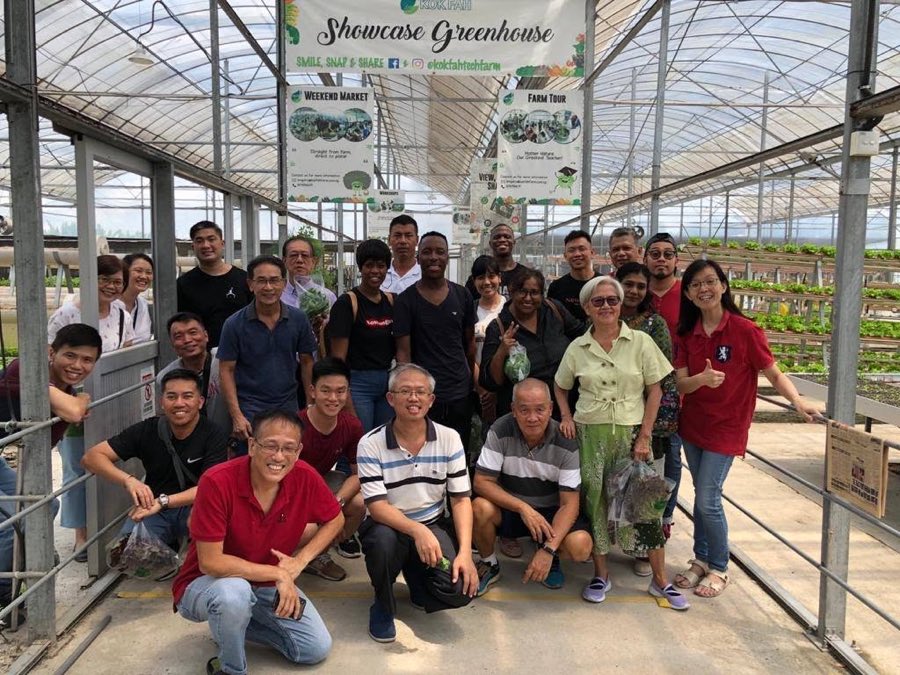
Everything in a commercial hydroponic farm is the same handful of ideas you can practise in a jam jar — hold the plant up, feed the roots, keep them oxygenated, keep light off the water. The farm just answers each one with engineering instead of with your hands, and repeats it at a scale that changes how the ideas feel.
Why the classroom comes first
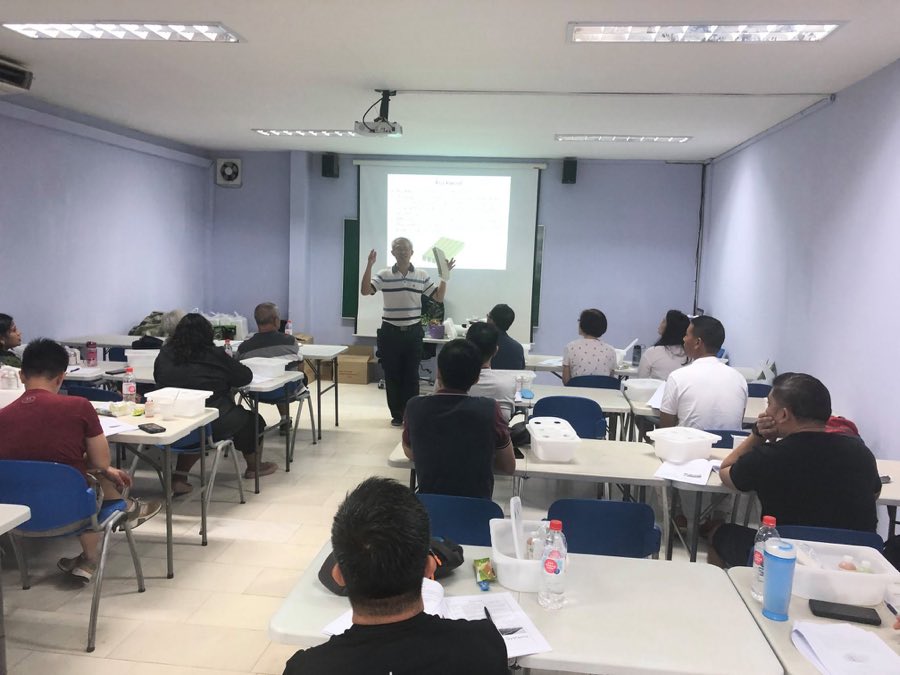
The day opens in a classroom, and the kits sit on the desks throughout. That sequencing is deliberate: you learn the vocabulary first — deep water culture, nutrient film technique, growing media, EC, pH — so that the farm walk is recognition rather than sightseeing.
Without the vocabulary, a greenhouse is a lot of green. With it, you look down a row and read it: that is NFT, those are net pots, that channel is running to a reservoir somewhere, and the spacing tells you what the crop cycle is.
It starts in the nursery, not the greenhouse
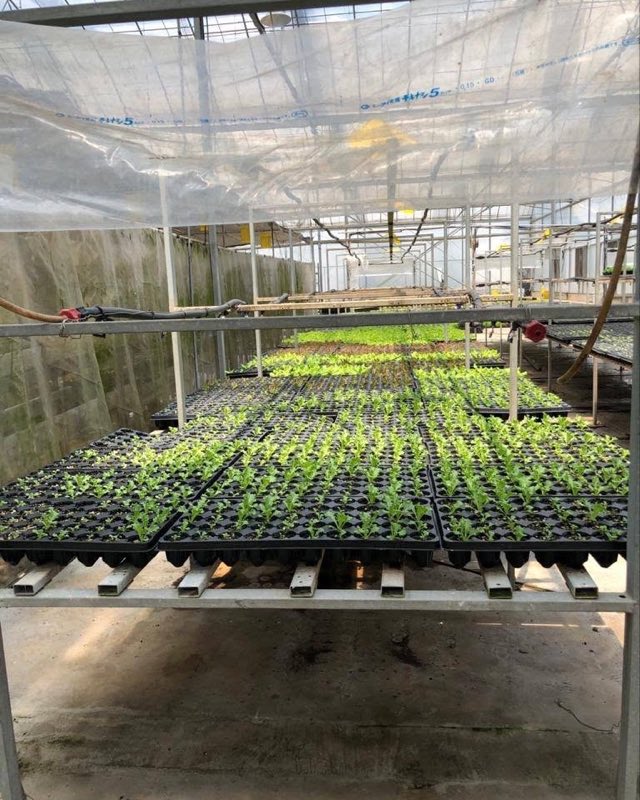
Every plant on the farm begins in a propagation tray, exactly as it does in a home kit — a seed in a small block of medium, kept damp until it germinates and puts out roots. The difference is bookkeeping. A farm germinates in batches, on a schedule, because the greenhouse downstream has to be filled continuously rather than all at once.
That is the first genuinely commercial idea most learners meet: staggered planting. If you seed everything on Monday, you harvest everything five weeks later and then have nothing for five weeks. Farms plant a fraction every week so the harvest is continuous, which is what turns growing into supplying.
Reading the growing systems
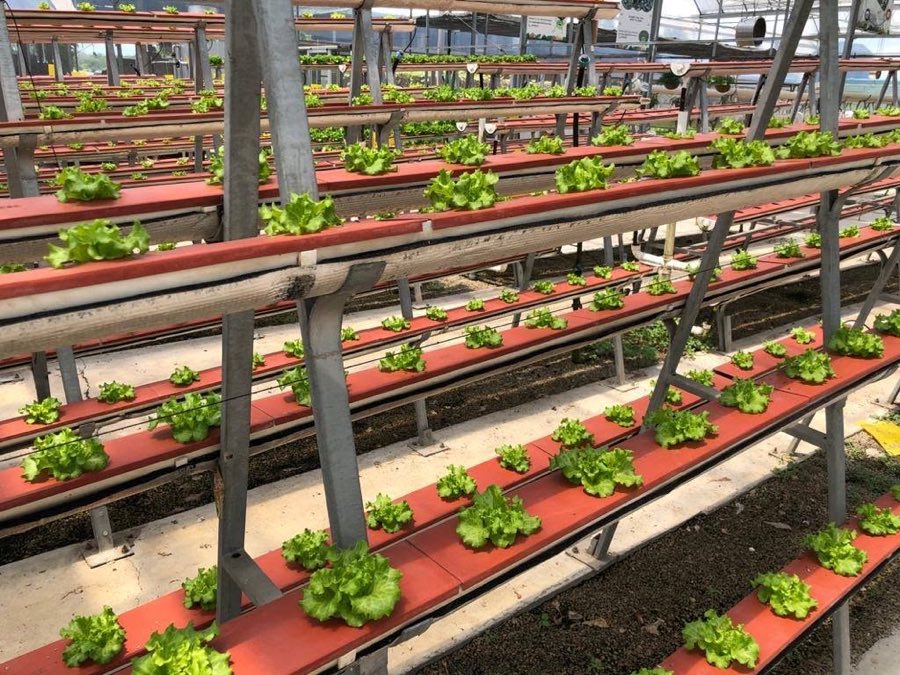
Those channels are nutrient film technique. A shallow, continuous film of nutrient solution flows down each one, past the bare roots, and drains back to a central reservoir to be recirculated. It is the same closed loop as a jar, with a pump doing the moving and gravity doing the returning.
Three details are worth stealing for a home system:
- The channels are tilted. A slight, consistent gradient is what keeps the film moving. Too flat and it pools and goes anoxic; too steep and it runs past the roots too fast to feed them.
- The film is thin on purpose. Roots sit in a shallow stream rather than a deep bath, so the upper root mass stays in humid air. That is how NFT solves oxygen without an air pump.
- Spacing is a decision, not a habit. The gaps are set for the plant's mature size, weeks before it gets there. Crowd them and you trap humidity between leaves and invite disease.
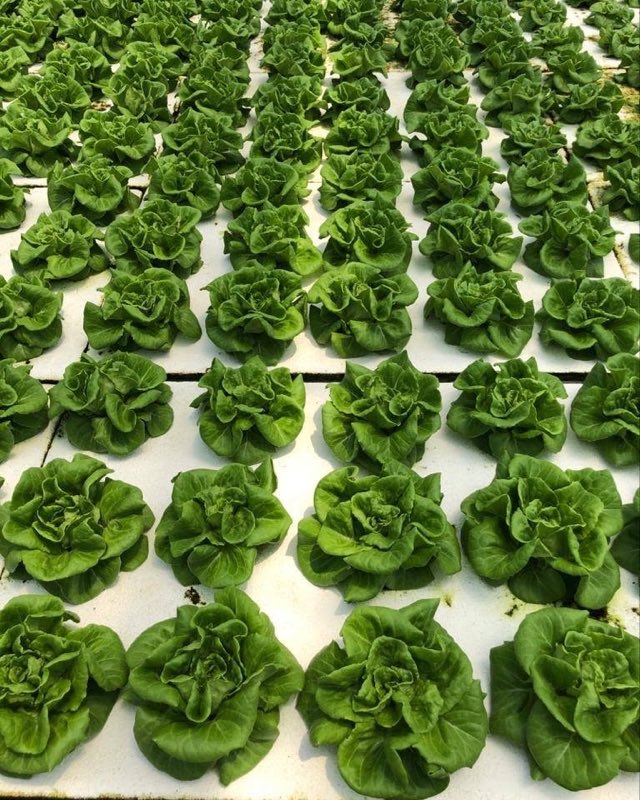
This is the other major method: plants held in boards floating on a body of nutrient solution, roots hanging straight down into it. It is deep water culture — the jam-jar method, scaled to a pond.
Look at the uniformity. Every head is roughly the same size at the same age, which almost never happens in soil, where each plant negotiates with its own patch of ground. Here every plant gets the same solution at the same concentration, so the variable that usually drives inconsistency has been removed. Predictable output is precisely what makes commercial growing financeable.
Learning at the bench
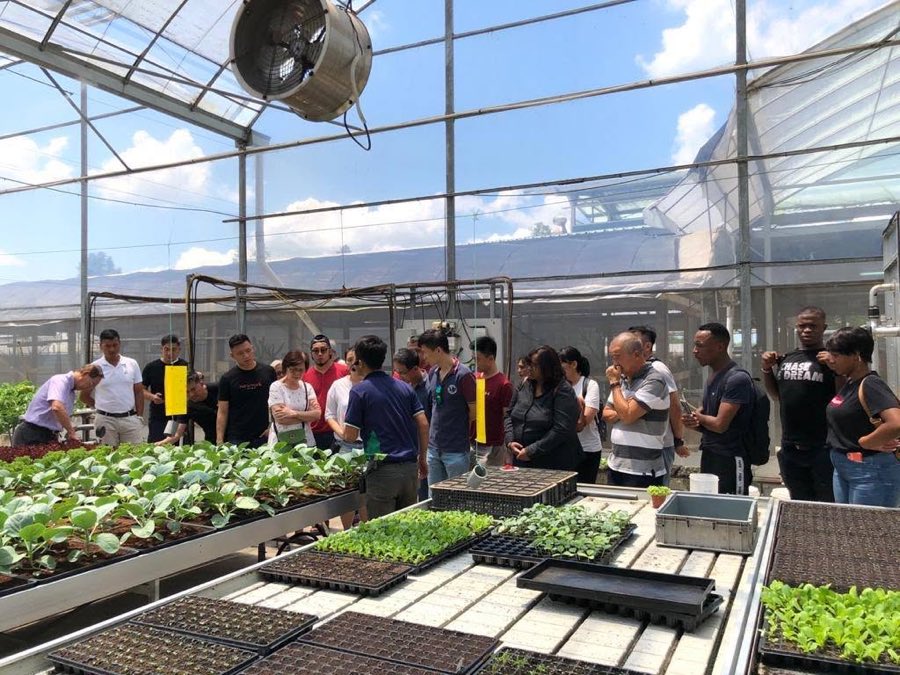
The most useful stretch of any farm visit is unstructured — standing at a bench asking someone who runs the system daily why it is built the way it is. Mr Chen Jun Wei has grown plants commercially in Singapore for years, and that experience is what the questions were really for. The answers are rarely elegant. Nutrient recipes get tuned to the local water supply. Layouts get shaped by what fits under an existing roof. Crop choices follow what sells at the market on Saturday, not what grows most easily.
Notice the yellow sticky traps hanging above the benches in the photographs. That is integrated pest management in its simplest form: monitor first, so you know what is present and in what numbers before you decide whether to intervene at all. A greenhouse excludes most pests, which is a large part of why hydroponic produce needs so much less spraying — but excluded is not the same as absent, and the traps are how you find out which.
Harvest, and what "fresh" actually means
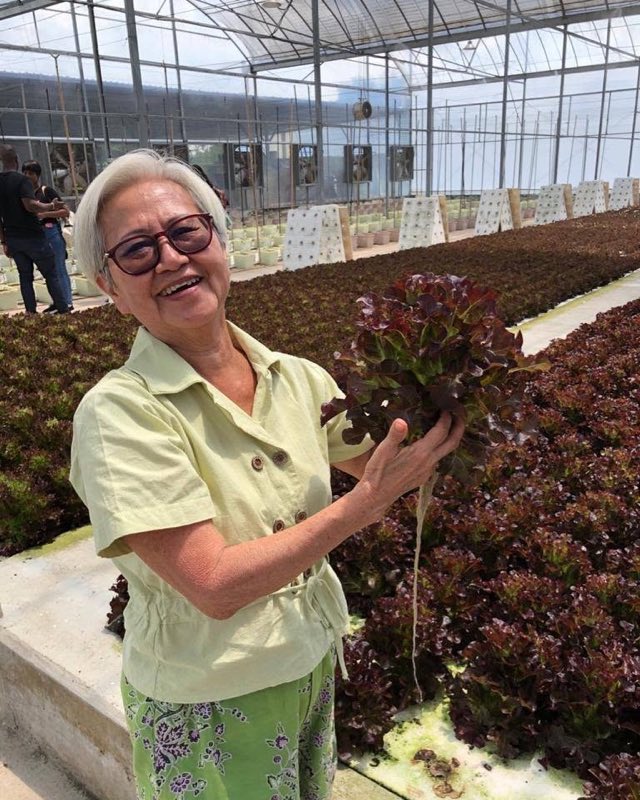
The roots are still on it. That is not a photo prop — hydroponic leafy greens are frequently sold root-attached, because a plant that has never been cut from its root system stays alive on the shelf and in your fridge for substantially longer than a cut head.
There is a local argument buried in that detail. Singapore imports the large majority of its food, and imported leafy greens spend days in transit before they arrive. A head harvested that morning at a farm in Singapore, roots intact, is operating on a completely different clock. That is the case for local production stated as a vegetable rather than as a policy target.
What the class takes back
The point of standing in a commercial greenhouse is not to make anyone want to build one. It is that the trip collapses the perceived distance between a jar on a windowsill and a farm:
- The principles do not change with scale. Support, feed, oxygenate, keep light off the water. A pump is a convenience, not a new idea.
- Measurement is the whole discipline. A farm cannot eyeball thousands of plants. It monitors EC and pH and acts on the numbers — the same habit that keeps one jar alive.
- Consistency is the product. Controlled conditions are what make every head the same size, and that uniformity is the actual commercial output.
- Scheduling is the commercial skill. Staggered planting is what separates growing food from supplying it.
Our current WSQ - Basic Urban Farming with Hydroponics course keeps this structure: theory, hands-on practice with a hydroponics kit, and a guided tour of a commercial hydroponics farm, all in one day.
The course today
WSQ - Basic Urban Farming with Hydroponics (course code TGS-2025053916) is a 1-day, 8-hour class at Beginner level with a 1-hour assessment, held at MEOD Farm, 13 Neo Tiew Harvest Lane. It maps to the SkillsFuture Skills Framework TSC Urban Farming Implementation and Management Control (AGR-FOP-2002-1.1), with two learning outcomes:
- Perform farming activities and equipment operations according to standard operating procedures
- Execute farming operations work in accordance with regulations, WSH practices and housekeeping rules
The day covers hydroponic system types (deep water culture, nutrient film technique, wick, ebb and flow, drip), growing media, plant nutrition and nutrient solutions, pH and EC monitoring, indoor farming conditions including lighting and humidity, Singapore's urban farming regulations, good agriculture practices and workplace safety.
What it costs
The full fee is $350 before GST. With WSQ funding:
| Who you are | Nett fee | Funding |
|---|---|---|
| Singapore Citizen / PR, aged 21 and above | $206.50 | 50% course-fee funding |
| Singapore Citizen aged 40 and above (MCES), or SME-sponsored | $136.50 | 70% course-fee funding |
GST of $31.50 (9%) applies to the full course fee. Funding is valid from 24 March 2025 to 23 March 2027. Eligible Singapore Citizens can apply SkillsFuture Credit and PSEA against the nett fee, NTUC members may claim UTAP, and employers can tap SFEC with Absentee Payroll support. Completion — at least 75% attendance plus a pass in the assessment — earns a Certificate of Achievement from Tertiary Infotech Academy and an OpenCert (Statement of Achievement) from SkillsFuture Singapore.
Check the next class date and funding eligibility →
Frequently asked questions
Does the course still include a commercial farm visit?
Yes. The current one-day course includes a guided tour of a commercial hydroponics farm alongside the classroom theory and hands-on kit practice. The class is held at MEOD Farm, 13 Neo Tiew Harvest Lane, so the working-farm context is built into the venue rather than bolted on.
What is the difference between NFT and deep water culture?
In nutrient film technique a thin film of solution flows continuously down a slightly tilted channel past bare roots and recirculates. In deep water culture the plants sit in boards above a body of solution with roots hanging into it. NFT uses less solution and gets oxygen from the shallow film; DWC is more forgiving of a pump failure because the reservoir is large. Both are covered in the course.
Why are hydroponic vegetables sold with the roots still attached?
Because the plant stays alive. A head that has never been cut from its root system keeps far better on the shelf and in your fridge than a cut one, which starts deteriorating immediately. It is also a visible signal of how recently it was harvested.
Do commercial hydroponic farms use pesticides?
Far less than open-field farming. A greenhouse physically excludes most pests, and growers monitor with simple tools such as yellow sticky traps so they know what is actually present before deciding whether to act. Removing soil also removes an entire category of soil-borne disease.
Do I need to want to start a farm to find this useful?
No. Most participants are growing at home or are simply curious. Seeing production scale is what makes the principles concrete — you return to your own small system understanding why spacing, scheduling and measurement matter, because you have seen what happens when they are taken seriously.
Where to go next
Between a jar on a windowsill and a greenhouse of ten thousand lettuces, the difference is engineering and scheduling. The ideas are the same, which means the ideas are learnable in an afternoon and improvable for years.
- Start small with leafy greens and run a full crop cycle before scaling anything.
- Join the next WSQ - Basic Urban Farming with Hydroponics class — from $136.50 nett for eligible Singapore Citizens aged 40 and above — and see a working farm alongside the hands-on practice.
- When you visit a farm, ask why rather than what. The reasoning behind the layout is the part you can actually reuse.
More from this course: hydroponics in a jam jar, building a deep water culture kit step by step, growing melons hydroponically, and why hydroponics matters for Singapore.