You have no items in your shopping cart.
Blog / Why Grow Lights Are Pink: Indoor Urban Farming Under LEDs
Why Grow Lights Are Pink: Indoor Urban Farming Under LEDs
Walk past an indoor farm at night and the windows glow an unmistakable pink-purple. It looks futuristic, and slightly odd, and the first question everyone asks is why.
The answer is the whole reason LED lighting changed indoor growing: that colour is what is left when you stop wasting energy on light plants cannot use.
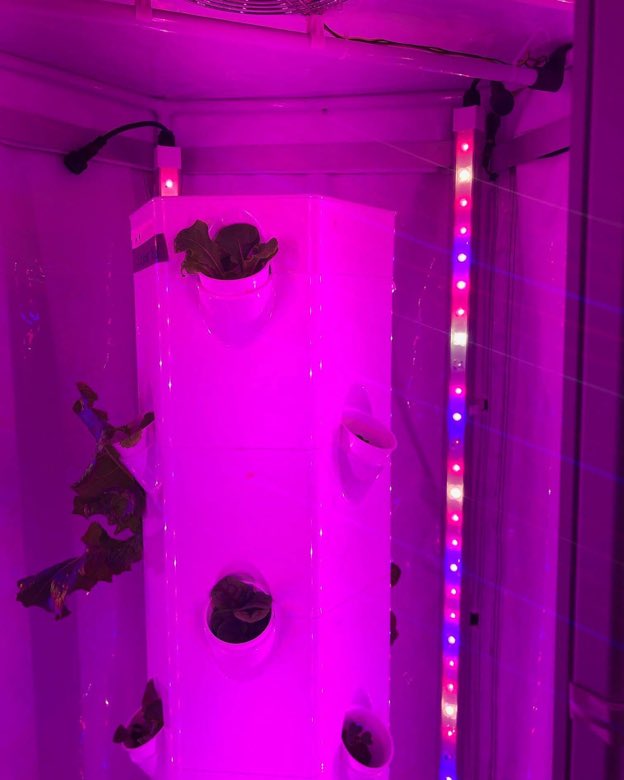
Look at the light strip on the right of that photograph. It is not pink. It is a row of separate red and blue diodes, and the magenta you see is those two colours mixing in the air and on the walls.
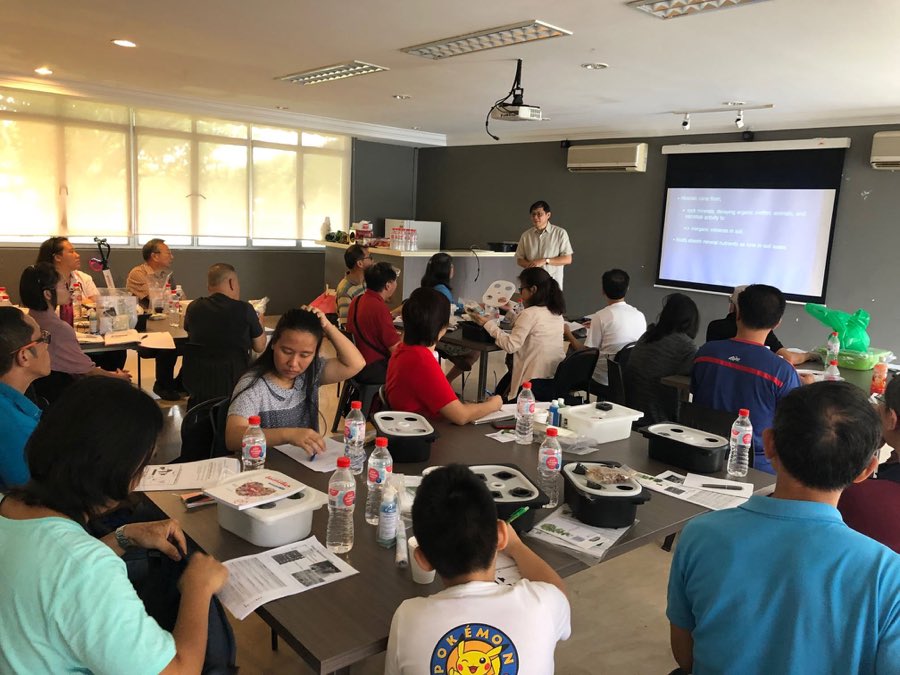
Our class on 10 November 2018 was built around this: indoor urban farming, where you supply the light instead of the sun.
Why red and blue
Plants do not use light evenly across the spectrum. Chlorophyll absorbs strongly in the blue and red bands and reflects most of the green in between — which is precisely why leaves look green to us. The green light is the part the plant is sending back.
Sunlight delivers the whole spectrum and the plant simply ignores what it does not need, which costs nothing because the sun is free. Indoors you are paying for every watt, so a lamp that emits mostly green light is paying to produce something the crop reflects away. LEDs can be built to emit narrow bands, so a grow light gives the plant red and blue and skips most of the rest.
Roughly speaking, and this is the version worth remembering:
- Blue favours compact, sturdy vegetative growth. Too little of it and seedlings stretch tall and thin, reaching for light they cannot find.
- Red drives biomass and flowering, and is the more energy-efficient band for a diode to produce.
- Both together is why the fixture reads magenta, and why full-spectrum white lamps — which do work — use more energy for the same growth.
The fixture, and the two things that matter about it
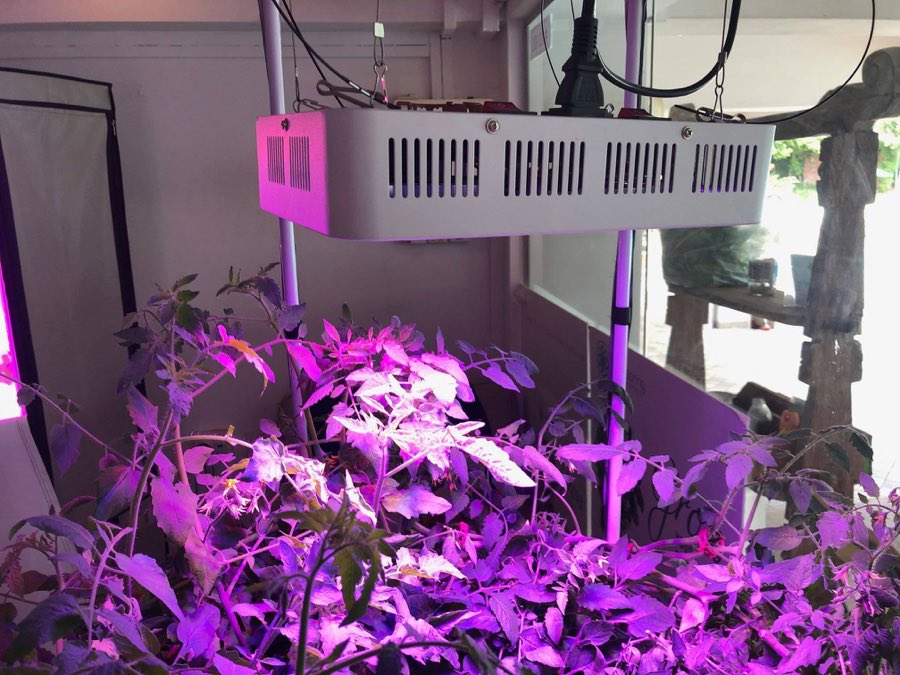
Two details in that photograph do more work than the specification sheet.
It hangs on adjustable cables. Light intensity falls off sharply with distance, so lamp height is the main control you have over how much light the canopy receives — and it has to be raised as the plants grow. Too close and you scorch the tops; too far and you get the same leggy stretching as too little light. A fixed lamp is a fixture you will fight.
It is vented, with fans. LEDs are far more efficient than the lamps they replaced, but they still produce heat, and heat in a small enclosed space raises temperature and drops humidity around the plants. In Singapore, where the ambient starting point is already warm, ventilation is not optional.
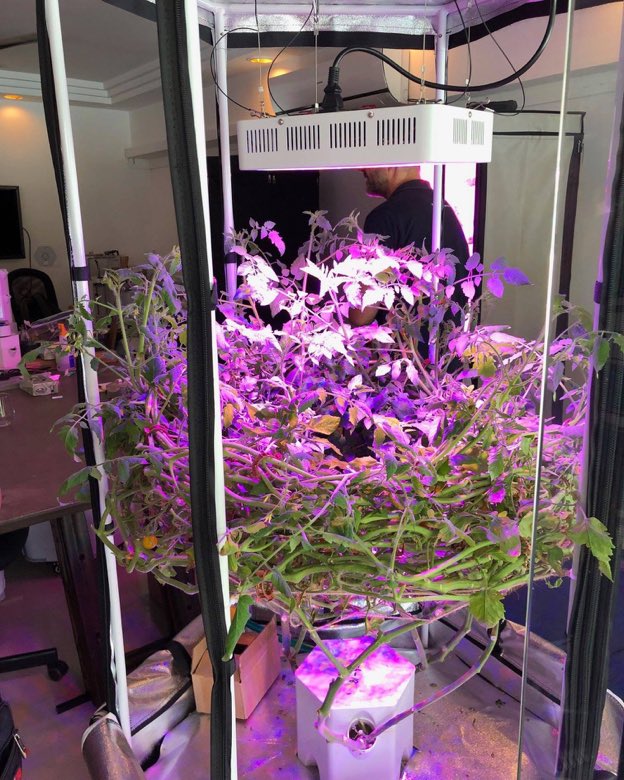
The tent around it is not just tidiness. Its reflective interior bounces light that would otherwise be lost back onto the plants, so more of what you are paying for reaches the canopy. It also contains the humidity and lets you run the light on a schedule without lighting the whole room at 2am.
And the plants growing in it are tomatoes — a fruiting crop, under artificial light, indoors. This is the point at which most people stop thinking of indoor growing as a way to keep herbs alive on a windowsill.
Light is a schedule, not just a lamp
The question the class kept returning to was not which lamp to buy but how long to run it. Indoors you control the day length entirely, which is a genuine advantage and an easy thing to get wrong:
- Plants need darkness. Respiration and much of a plant's growth happen in the dark period. Running lights 24 hours does not double growth; it stresses the plant.
- Consistency beats intensity. A steady daily cycle on a timer outperforms a brighter lamp switched on and off by hand when someone remembers.
- Leafy greens are forgiving; fruiting crops are not. Lettuce tolerates a fairly wide range. Tomatoes want more light and a properly maintained cycle to set fruit.
- Electricity is the running cost. Lighting, not nutrients, is what indoor growing actually costs to operate — which is why efficiency is the whole argument for LEDs.
Growing without a farm at all
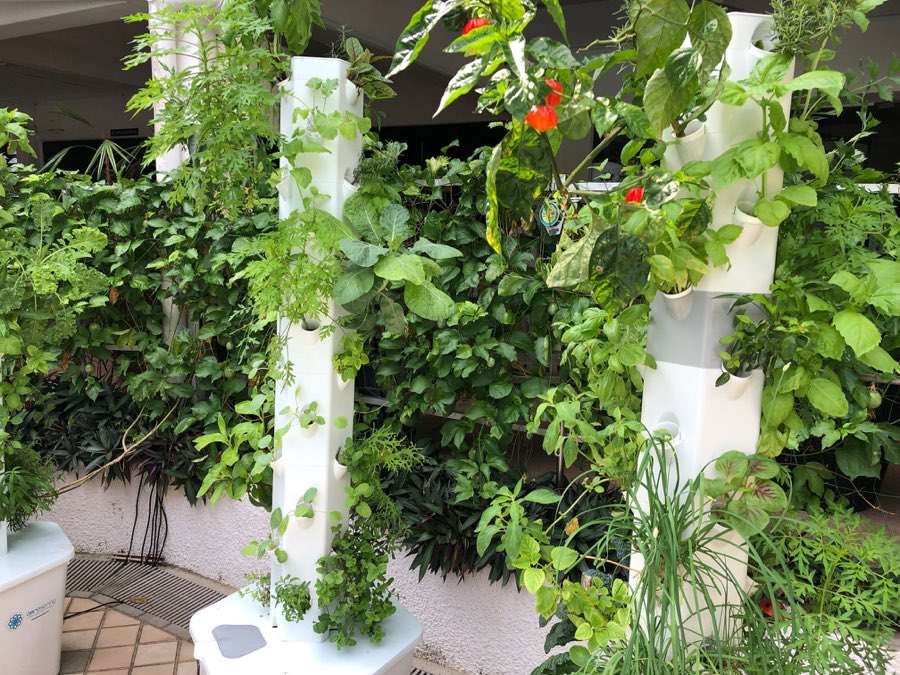
The same session covered vertical tower systems, which answer the space problem the way LEDs answer the light problem. A tower grows upward from a footprint about the size of a large plant pot, with planting sites spiralling around it, so a corridor or balcony corner becomes productive area.
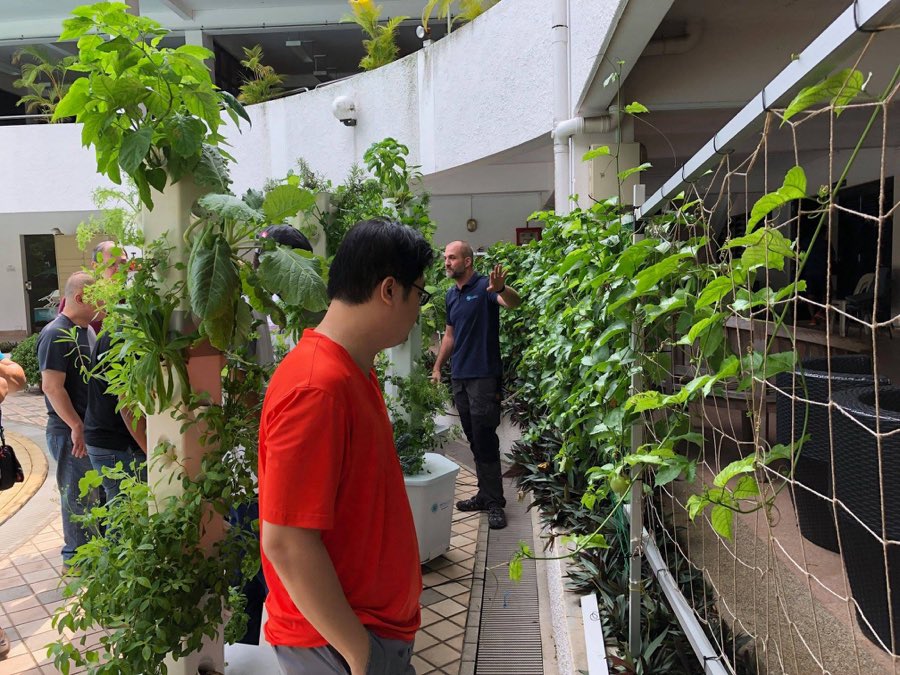
Put the two ideas together — vertical growing plus supplied light — and the constraint that normally decides whether you can grow food disappears. You no longer need land, and you no longer need a sunny aspect. You need a power point and somewhere to stand the tower.
What this means for a flat in Singapore
The practical consequence is that a north-facing flat with no usable balcony is no longer disqualified from growing food. With LEDs:
- Any room becomes a growing space. A shelf, a lamp on adjustable cables, and a timer.
- The season stops mattering. You set the day length yourself, and it is the same every day of the year.
- Cost moves from land to electricity, which is the trade that makes indoor farming viable at small scale — and the reason efficiency matters.
- You still have to do the hydroponics properly. Lights do not compensate for a badly mixed solution or a pH you have never measured.
That last point is the one to hold on to. LEDs solve the light problem. They do not solve any of the others, which is what the rest of the course is about.
The course today
WSQ - Basic Urban Farming with Hydroponics (course code TGS-2025053916) is a 1-day, 8-hour class at Beginner level with a 1-hour assessment, held at MEOD Farm, 13 Neo Tiew Harvest Lane. It maps to the SkillsFuture Skills Framework TSC Urban Farming Implementation and Management Control (AGR-FOP-2002-1.1), with two learning outcomes:
- Perform farming activities and equipment operations according to standard operating procedures
- Execute farming operations work in accordance with regulations, WSH practices and housekeeping rules
Indoor farming conditions — lighting, temperature and humidity control — are part of the syllabus, alongside hydroponic system types, growing media, plant nutrition and nutrient solutions, pH and EC monitoring, Singapore's urban farming regulations, good agriculture practices and workplace safety, plus hands-on practice with a hydroponics kit and a guided tour of a commercial hydroponics farm.
What it costs
The full fee is $350 before GST. With WSQ funding:
| Who you are | Nett fee | Funding |
|---|---|---|
| Singapore Citizen / PR, aged 21 and above | $206.50 | 50% course-fee funding |
| Singapore Citizen aged 40 and above (MCES), or SME-sponsored | $136.50 | 70% course-fee funding |
GST of $31.50 (9%) applies to the full course fee. Funding is valid from 24 March 2025 to 23 March 2027. Eligible Singapore Citizens can apply SkillsFuture Credit and PSEA against the nett fee, NTUC members may claim UTAP, and employers can tap SFEC with Absentee Payroll support. Completion — at least 75% attendance plus a pass in the assessment — earns a Certificate of Achievement from Tertiary Infotech Academy and an OpenCert (Statement of Achievement) from SkillsFuture Singapore.
Check the next class date and funding eligibility →
Frequently asked questions
Why are grow lights pink or purple?
Because they combine red and blue diodes, and those two colours blend to magenta. Chlorophyll absorbs strongly in the red and blue bands and reflects most green, so a lamp built to emit mainly red and blue delivers the wavelengths plants actually use without paying for light they reflect away.
Can I just use a normal LED bulb or a desk lamp?
Ordinary room lighting is designed for human eyes and is generally far too dim at plant level to grow much. Full-spectrum white grow lights do work and are pleasanter to sit near; they simply use more energy for the same growth than a red/blue fixture. The important variables are intensity at the canopy and hours per day, not the label on the box.
How far above the plants should the light hang?
Close enough to give useful intensity, far enough not to scorch, and adjusted as the plants grow — which is why grow panels hang on adjustable cables. Light intensity drops off sharply with distance. Seedlings stretching tall and thin are telling you they need more light or a lower lamp; scorched or bleached tops mean the opposite.
Should I run the lights 24 hours a day?
No. Plants need a dark period, and much of their growth and respiration happens in it. Continuous light stresses the plant rather than doubling growth. Put the lamp on a timer and keep the cycle consistent — regularity matters more than a brighter lamp switched on by hand.
Does the course cover indoor lighting?
Yes. Indoor farming conditions including lighting, temperature and humidity control are part of the syllabus, alongside the hydroponic systems, nutrient solutions and pH/EC monitoring that make up the rest of the day.
Can I grow fruiting crops indoors under LEDs?
Yes, though it is harder than leafy greens. The tomatoes in these photographs were growing under a panel in a grow tent. Fruiting crops want more light, a well-maintained day length, more root volume and a nutrient recipe that shifts as they move from leafy growth into fruiting. Start with greens and work up.
Where to go next
LEDs removed the last excuse. Not enough land was solved by hydroponics and vertical towers; not enough sun was solved by putting the light on a timer.
- Start with leafy greens on a shelf, one adjustable lamp, and a timer you never touch.
- Join the next WSQ - Basic Urban Farming with Hydroponics class — from $136.50 nett for eligible Singapore Citizens aged 40 and above.
- Log your light hours alongside pH and EC. When something goes wrong indoors, light is as often the cause as the solution is.
More from this course: how hydroponics works, hydroponics in a jam jar, building a deep water culture kit, inside a working hydroponic farm, and growing melons hydroponically.