You have no items in your shopping cart.
Blog / Where It Started: Our First Hydroponics Class in 2014, With the Late Dr Mallick
Where It Started: Our First Hydroponics Class in 2014, With the Late Dr Mallick
Every course has a first run. Ours was on 8 March 2014, in a room at Toh Orchid Farm, and it was taught by the late Dr Mallick — one of the people who did the early work of making hydroponics comprehensible to ordinary Singaporeans rather than only to agronomists.
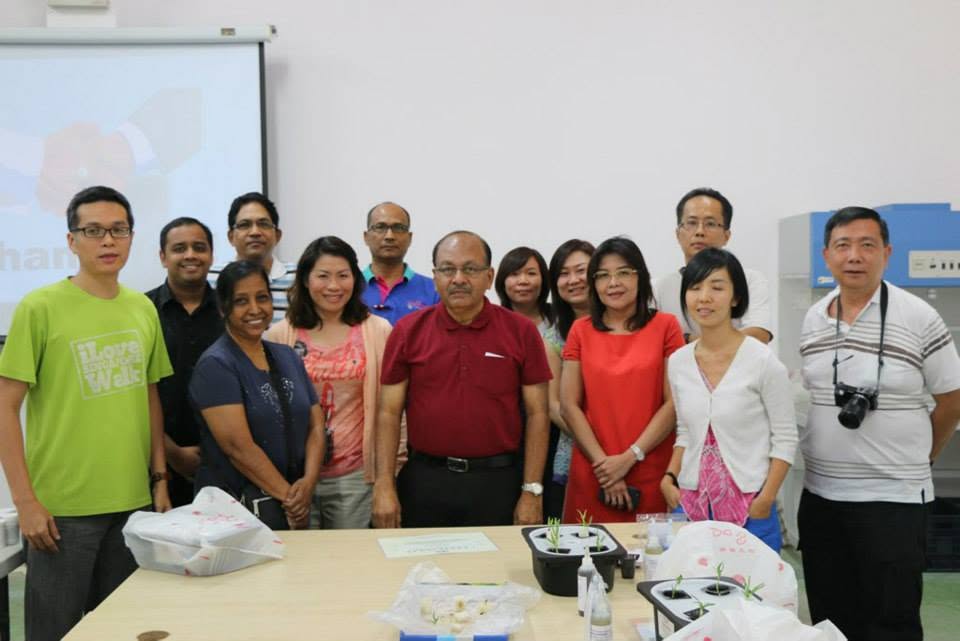
This post is partly an anniversary note and partly a thank-you. Almost everything that is still in the syllabus — the order of the lessons, the insistence on building a working system in the room, the refusal to let anyone leave without touching a seedling — traces back to how he taught it that day.
The lesson he opened with
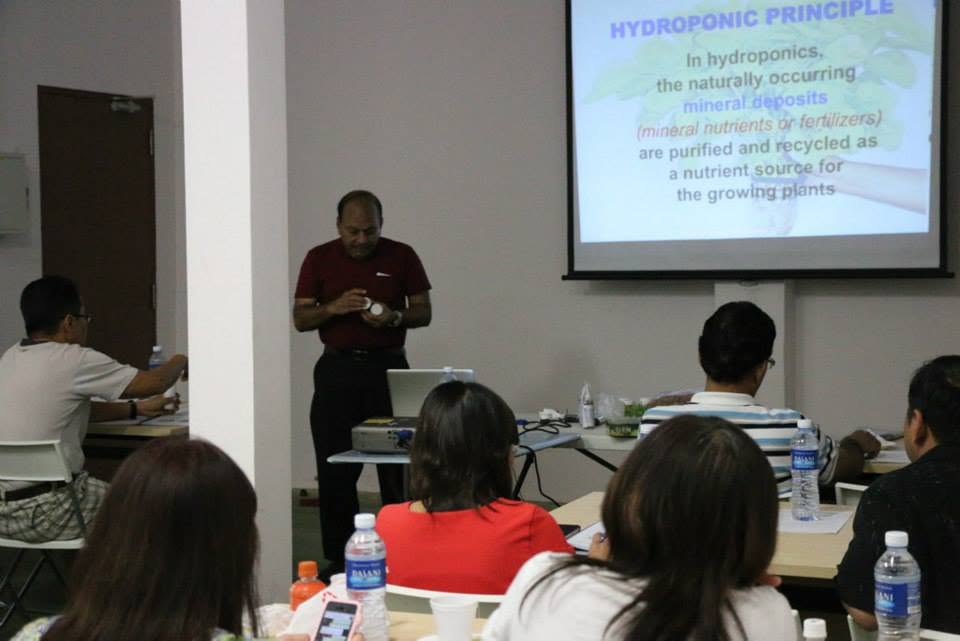
Read the slide. It is doing something careful.
In 2014, the most common objection to hydroponics was that it was somehow artificial — chemicals in water, as against honest dirt. Rather than argue, he reframed: the naturally occurring mineral nutrients plants normally take from soil are simply purified and recycled as a nutrient solution. Same elements, different delivery. The plant cannot tell the difference because there is no difference to tell.
Everything else in the course follows from that one idea. If soil is a delivery mechanism rather than the nutrition itself, then replacing it is an engineering problem, not a violation of anything. Eleven years on, we still open the class with the same point, and it still does the same work.
He would not let it stay theoretical
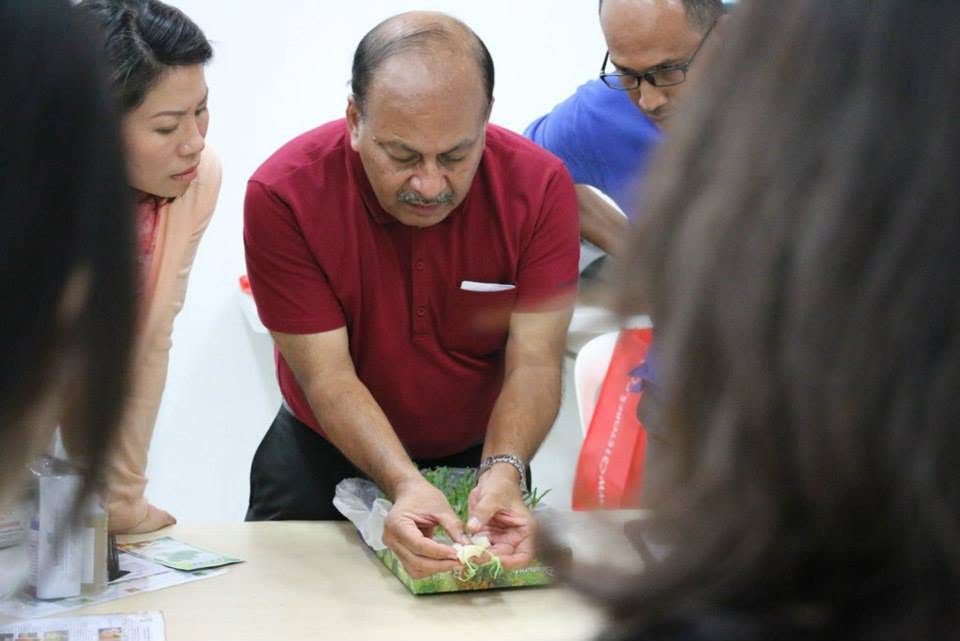
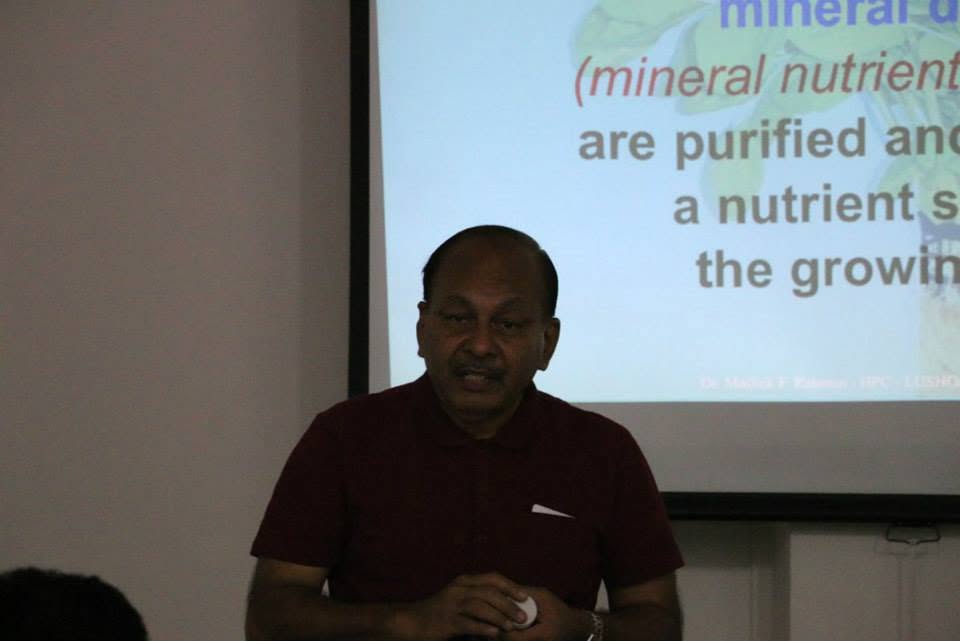
Look at how close the learners are standing. That is the actual teaching method, and it is the reason the course still runs the way it does.
He would explain something at the projector for a few minutes, then walk to a table and do it — seat a seedling in a net pot, show what a properly soaked medium feels like, point out the root that had already found the water. The lecture existed to make the demonstration legible, never the other way round.
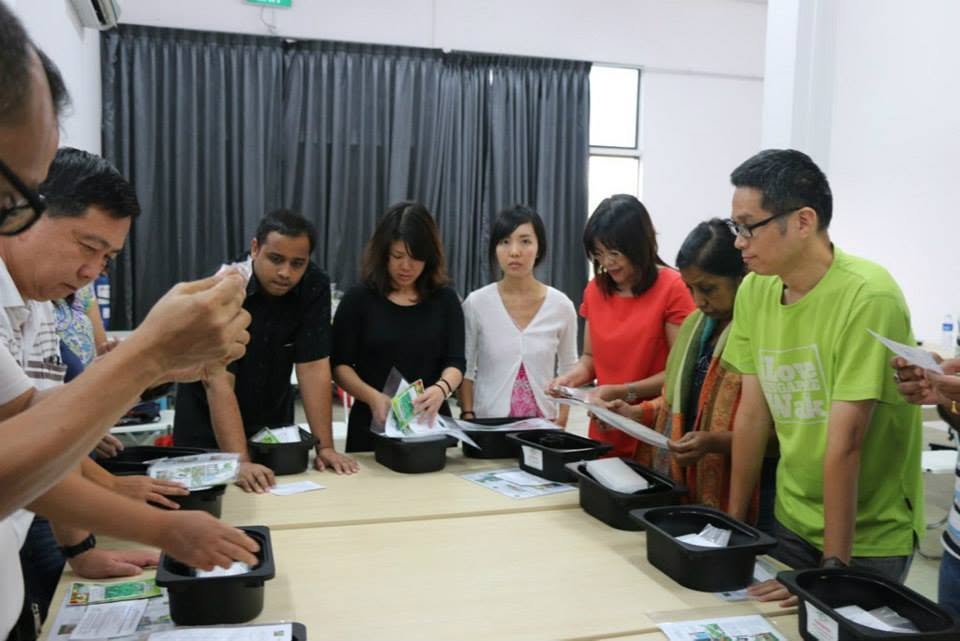
And then everyone built their own. Not a demonstration to watch, a tray each. That one decision is why people leave able to actually start, and it survived every revision of the course since.
Toh Orchid Farm
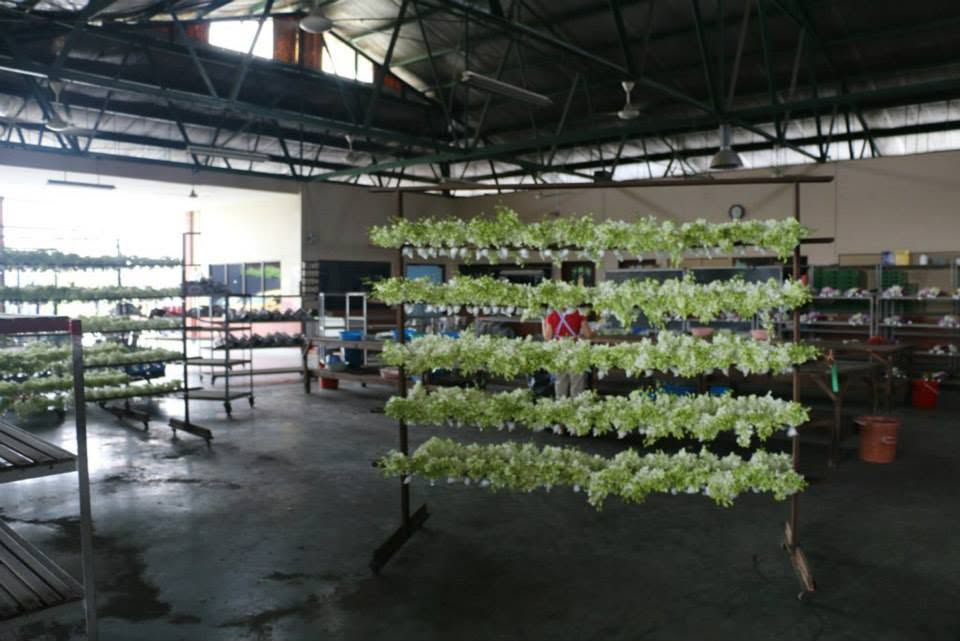
Holding the class on a working farm was deliberate. Learners walked out of the classroom and straight into a shed where plants were actually being grown and packed, and that stacked rack made the land argument without anyone needing to state it: the footprint of a cupboard, the growing area of a small plot.
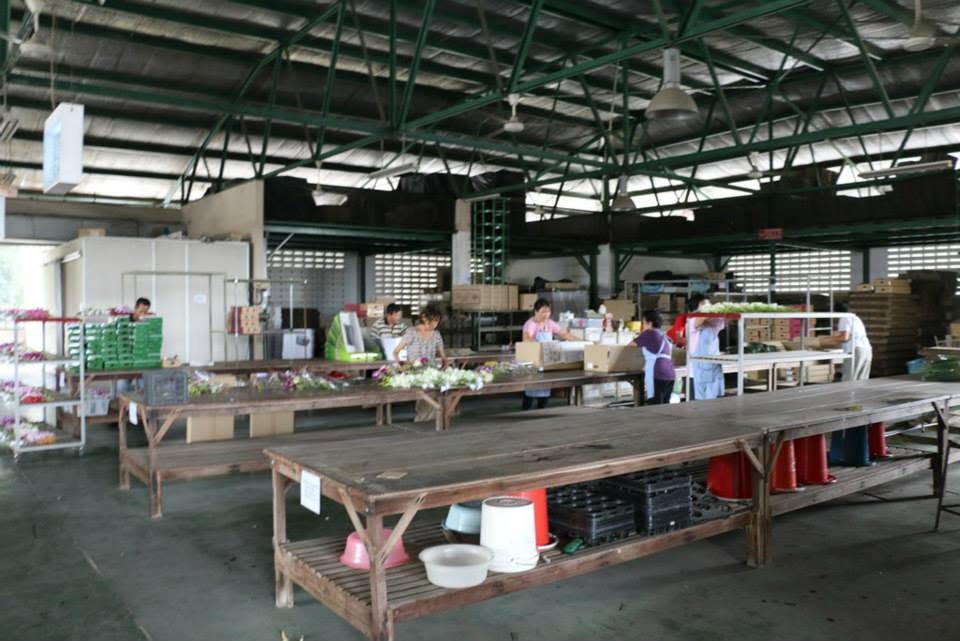
Singapore's growing scene looked very different then. The "30 by 30" goal had not been announced, commercial vertical farms were mostly a proposition rather than a sector, and a hydroponics class was a curiosity. What has changed since is the scale and the seriousness — not the principles, which is precisely the point of looking back at this.
What carried forward
Comparing that first run with the course as it stands today, four things came straight through:
- Lead with the principle, not the equipment. Once someone understands that roots absorb nutrients as ions in water, every system type becomes a variation rather than a new thing to memorise.
- Everyone builds one. A kit per learner, assembled in the room. Watching is not learning.
- Teach on a working farm. Theory in the morning, production reality in the afternoon, so the ideas have somewhere to land.
- Answer the "is it natural" question head-on. It is still the most common question, and it still deserves the careful answer he gave rather than a dismissive one.
The current WSQ - Basic Urban Farming with Hydroponics course has WSQ accreditation, an assessment, a Skills Framework mapping and funding that did not exist in 2014. Underneath the paperwork, it is recognisably the same class.
The course today
WSQ - Basic Urban Farming with Hydroponics (course code TGS-2025053916) is a 1-day, 8-hour class at Beginner level with a 1-hour assessment, held at MEOD Farm, 13 Neo Tiew Harvest Lane. It maps to the SkillsFuture Skills Framework TSC Urban Farming Implementation and Management Control (AGR-FOP-2002-1.1), with two learning outcomes:
- Perform farming activities and equipment operations according to standard operating procedures
- Execute farming operations work in accordance with regulations, WSH practices and housekeeping rules
The day covers hydroponic system types, growing media, plant nutrition and nutrient solutions, pH and EC monitoring, indoor farming conditions, Singapore's urban farming regulations, good agriculture practices and workplace safety — plus hands-on practice with a hydroponics kit and a guided tour of a commercial hydroponics farm.
What it costs
The full fee is $350 before GST. With WSQ funding:
| Who you are | Nett fee | Funding |
|---|---|---|
| Singapore Citizen / PR, aged 21 and above | $206.50 | 50% course-fee funding |
| Singapore Citizen aged 40 and above (MCES), or SME-sponsored | $136.50 | 70% course-fee funding |
GST of $31.50 (9%) applies to the full course fee. Funding is valid from 24 March 2025 to 23 March 2027. Eligible Singapore Citizens can apply SkillsFuture Credit and PSEA against the nett fee, NTUC members may claim UTAP, and employers can tap SFEC with Absentee Payroll support. Completion — at least 75% attendance plus a pass in the assessment — earns a Certificate of Achievement from Tertiary Infotech Academy and an OpenCert (Statement of Achievement) from SkillsFuture Singapore.
Check the next class date and funding eligibility →
Frequently asked questions
Is hydroponics natural, or is it just chemicals in water?
It is the same question Dr Mallick answered in 2014, and the answer has not changed. The nutrients are the naturally occurring mineral elements plants would otherwise take up from soil, purified and dissolved in water so roots can absorb them directly. Plants take three elements from air and water and thirteen as minerals, whichever way you grow them.
How has the course changed since 2014?
It is now WSQ-accredited with a formal assessment, mapped to a Skills Framework competency, and eligible for WSQ funding, SkillsFuture Credit, PSEA and UTAP — none of which applied in 2014. The teaching structure is largely unchanged: principle first, a kit per learner, and a working farm as the venue.
Do I still build my own system in class?
Yes. Hands-on practice with a hydroponics kit is part of the day, exactly as it was in 2014. Watching someone else assemble a system teaches you very little; doing it yourself is what makes the sequence stick.
Where is the class held now?
At MEOD Farm, 13 Neo Tiew Harvest Lane, Singapore 719838. The 2014 class was at Toh Orchid Farm; the venue has changed over the years but the principle of teaching on a working farm has not.
Do I need any background to join?
None. The course is Beginner level and assumes no farming or science background. Hydroponics rewards careful measurement more than a green thumb.
Where to go next
Eleven years on, the reason to learn this is stronger than it was in 2014: Singapore still imports the large majority of its food, and the people who can run these systems are the capability behind every local farm.
- Start with leafy greens and herbs — fast, forgiving, and honest about your mistakes within weeks.
- Join the next WSQ - Basic Urban Farming with Hydroponics class — from $136.50 nett for eligible Singapore Citizens aged 40 and above.
- Build your own system in the room, then keep it alive through one full crop cycle. That is the whole apprenticeship.
More from this course: how hydroponics works, hydroponics in a jam jar, building a deep water culture kit, inside a working hydroponic farm, and growing melons hydroponically.