You have no items in your shopping cart.
Blog / A Full Room and a Kit Each: Our 25 July 2015 Hydroponics Class
A Full Room and a Kit Each: Our 25 July 2015 Hydroponics Class
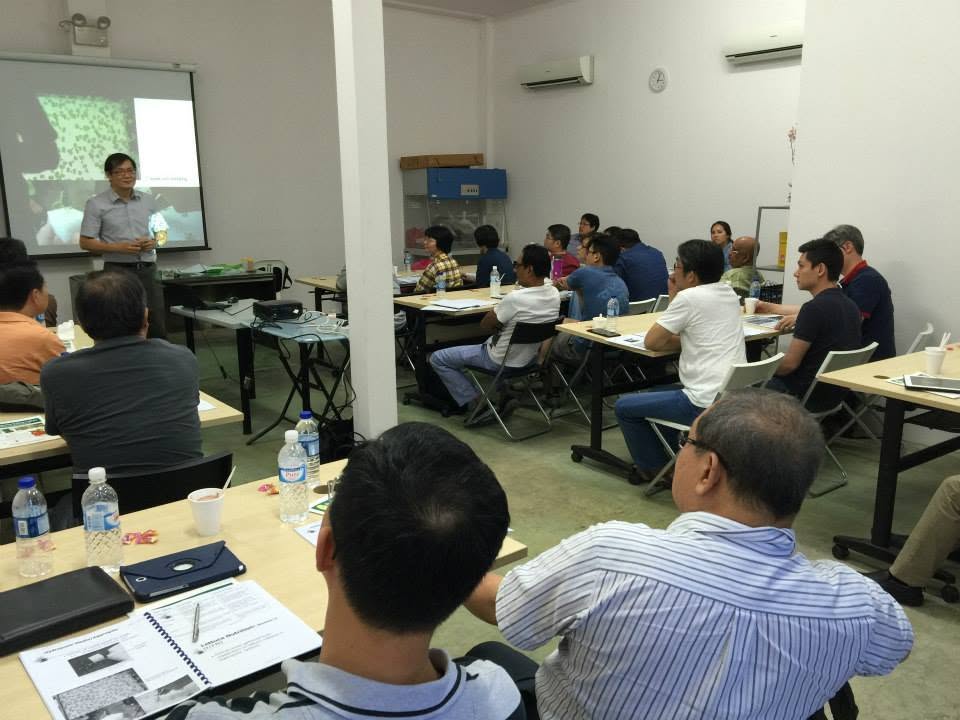
By the middle of 2015 our hydroponics classes had stopped being a curiosity and started filling up. The class on 25 July 2015 at Toh Orchid Farm was one of the biggest we had run: a long table down each side of the room, a grow kit in front of every seat, and Geoffrey Chow teaching.
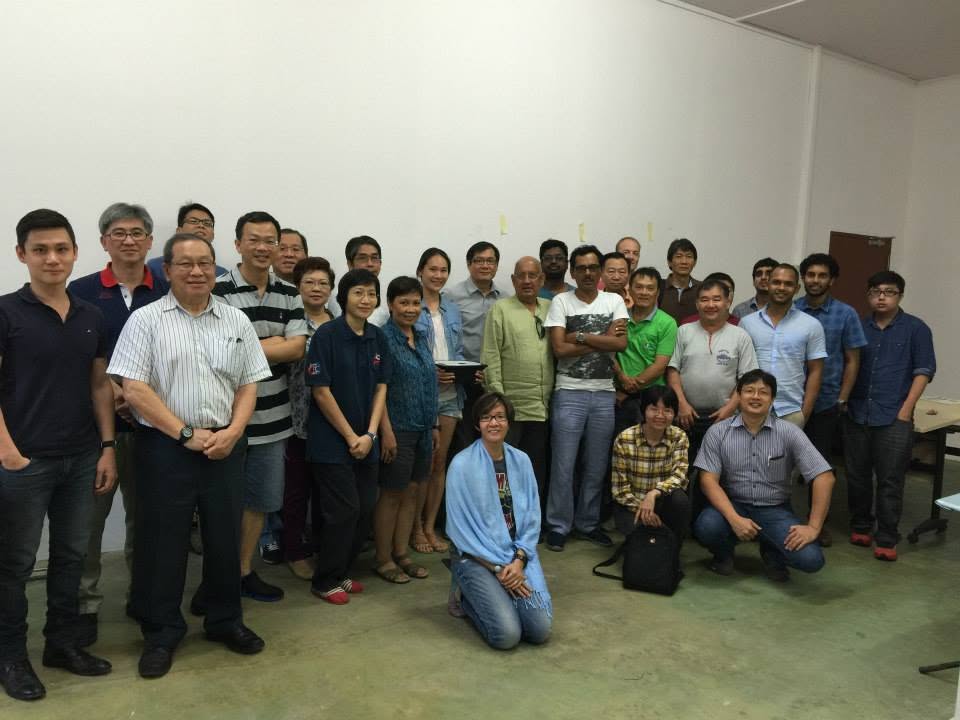
This is a look back at what a hands-on hydroponics class looked like in Singapore a decade ago — before the "30 by 30" goal was announced, before vertical farms were a sector, and well before anyone was calling this a national capability.
Taught by someone who had built the systems
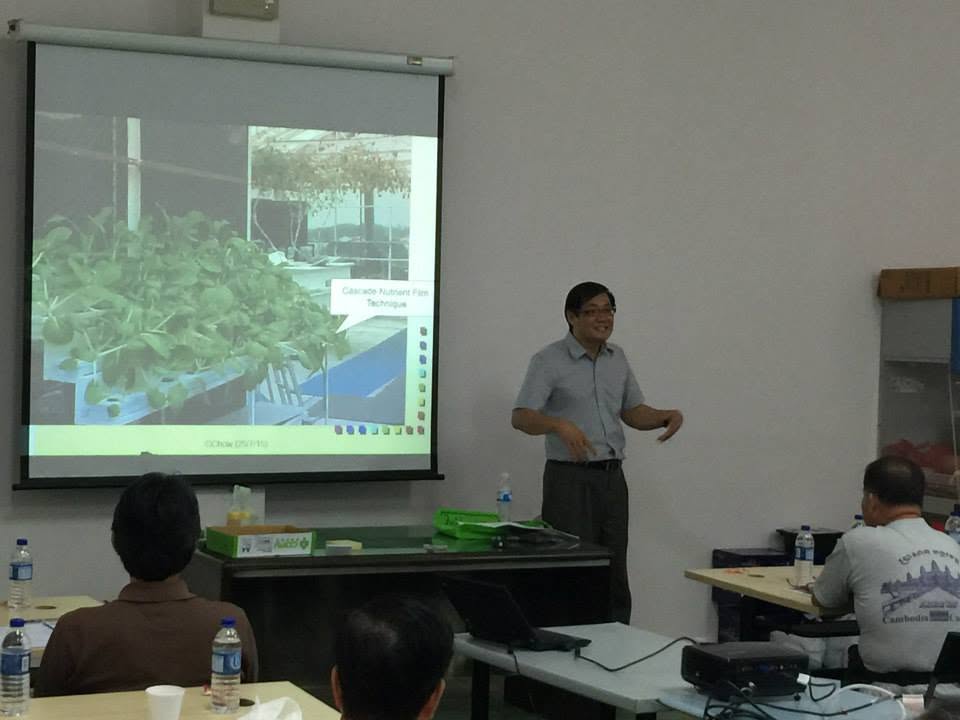
Look at what is on the screen: a cascade nutrient film technique system, photographed in a real greenhouse rather than lifted from a textbook. The slide carries his own credit line in the corner.
That is the difference a practitioner makes. A trainer working from a manual can tell you a cascade NFT system stacks channels so solution falls from one level to the next. A trainer who has built one tells you which joints leak, how much fall you actually need between tiers, and what happens on the day the pump stops. The questions people asked in that room were answerable because the person at the front had already made the mistakes.
A kit each — not a demonstration
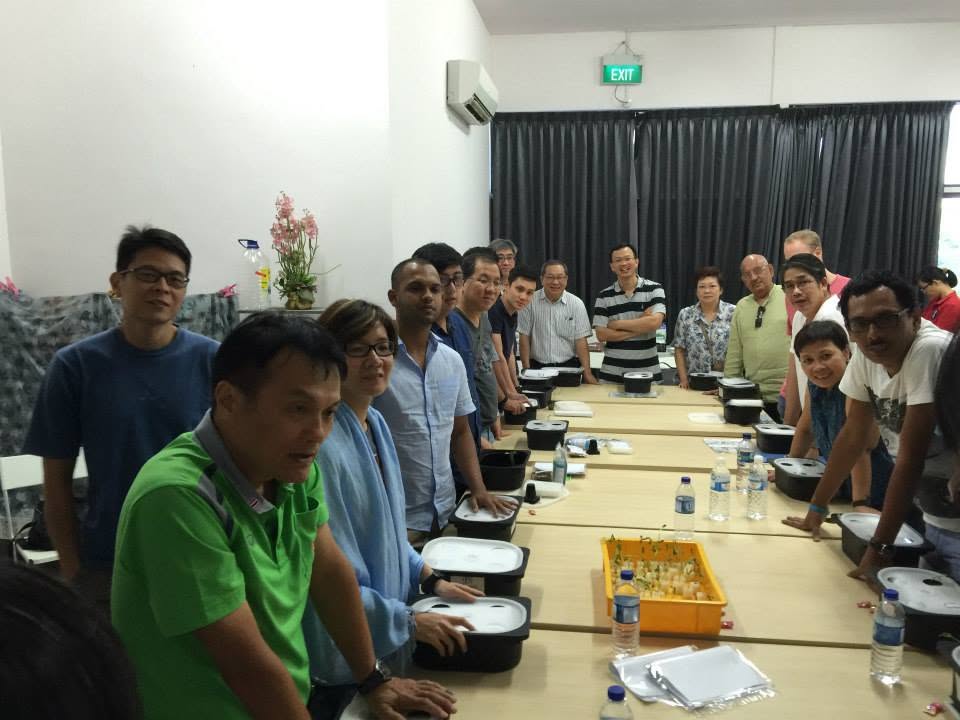
Count the tubs. That is the rule the course has never broken: one working system per learner, assembled by that learner, in the room. It is the single most expensive decision in running a class like this and the one that most determines whether anyone actually grows anything afterwards.
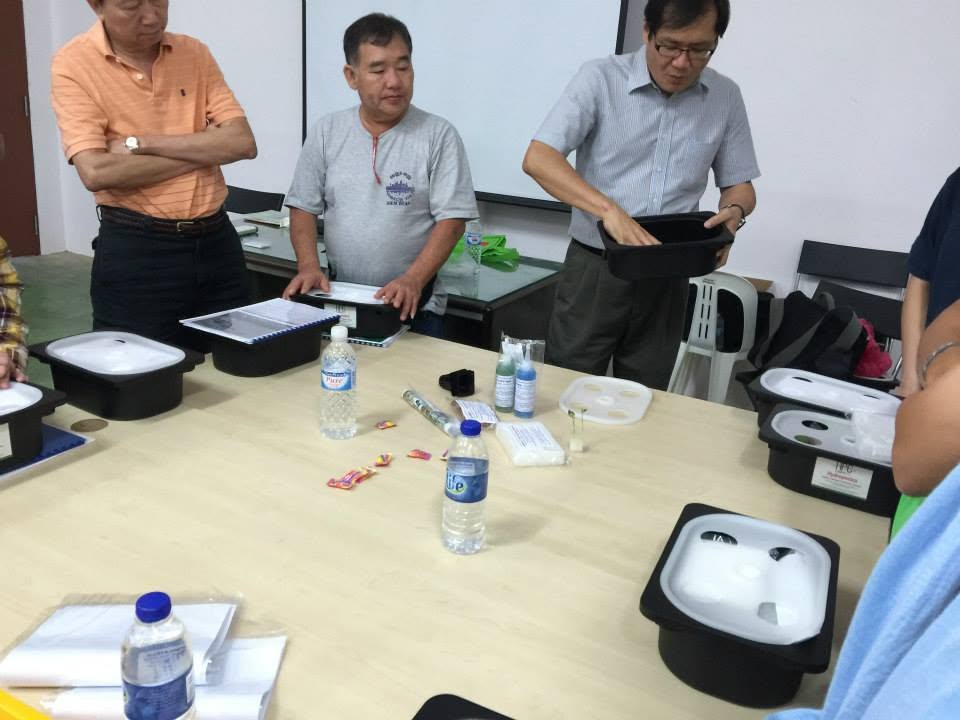
The practical session is where the theory gets tested against your hands. The lid has to sit so the net pots hold the medium at the right depth — close enough to the solution that it wicks upward, not so deep that the medium is submerged and the roots suffocate. You can describe that in a sentence. You only really learn it by holding the pot and deciding.
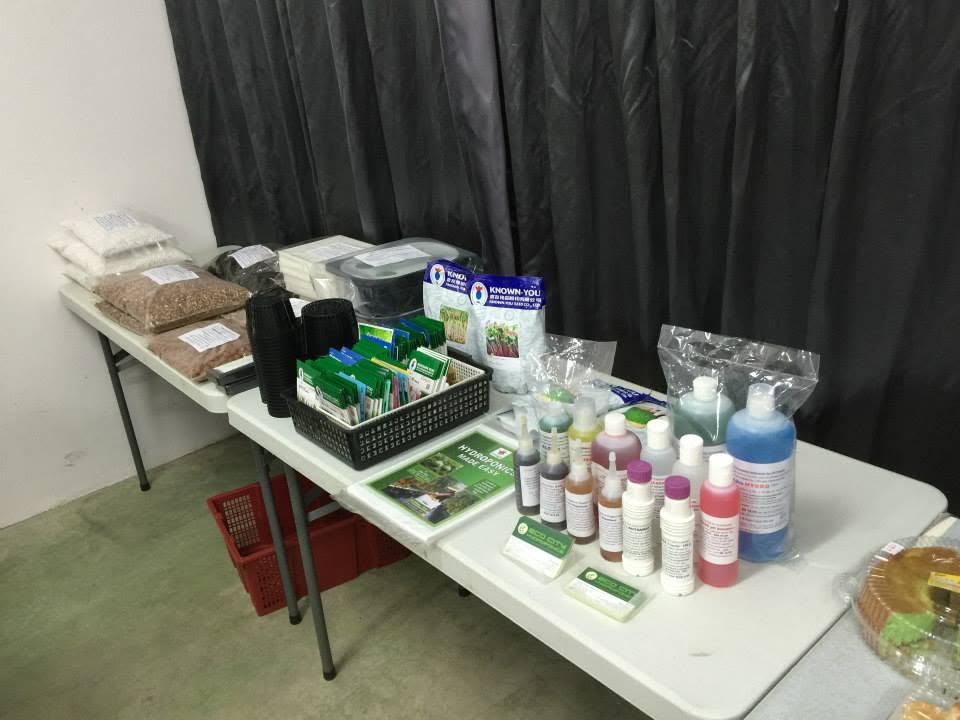
And this is the answer to "what do I actually need to buy" — a question every class asks. Nutrient A and B concentrates, pH up and down, a growing medium, net pots, seed. The list is short and unglamorous, which is usually a relief to hear.
Everyone leaves with something that works
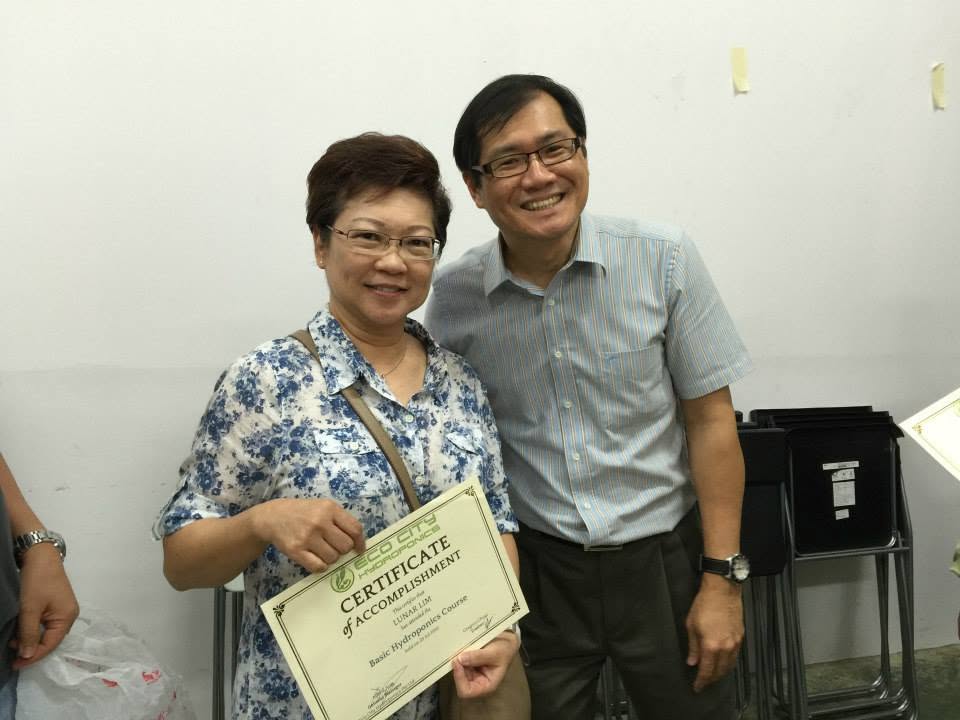
The certificate mattered less than the tub, honestly — but both went home. In 2015 that was a Certificate of Accomplishment from the course provider. The course today carries WSQ accreditation, a formal assessment, a Skills Framework mapping and an OpenCert from SkillsFuture Singapore, none of which existed for this class.
What has not changed is the shape of the day: understand the principle, build the system, take it home, keep it alive.
What a decade changed — and what it did not
Comparing 2015 with a class we run now:
- The context changed completely. In 2015 hydroponics was a hobby with an interesting future. Singapore has since set a national food-production target, commercial vertical farms have opened, and the skill has funding attached to it.
- The accreditation arrived. WSQ funding, SkillsFuture Credit, PSEA and UTAP now bring a $350 course down to $206.50 or $136.50 nett. In 2015 you simply paid the fee.
- The equipment got cheaper and better. Meters that were specialist purchases are now commodity items, which matters because measurement is the whole discipline.
- The physics did not move at all. Roots still need water, nutrients and oxygen. pH still decides whether a plant can absorb what is in the tank. A lid still keeps algae out of a reservoir. Everything taught in that room in 2015 is still true.
The course today
WSQ - Basic Urban Farming with Hydroponics (course code TGS-2025053916) is a 1-day, 8-hour class at Beginner level with a 1-hour assessment, held at MEOD Farm, 13 Neo Tiew Harvest Lane. It maps to the SkillsFuture Skills Framework TSC Urban Farming Implementation and Management Control (AGR-FOP-2002-1.1), with two learning outcomes:
- Perform farming activities and equipment operations according to standard operating procedures
- Execute farming operations work in accordance with regulations, WSH practices and housekeeping rules
The day covers hydroponic system types (deep water culture, nutrient film technique, wick, ebb and flow, drip), growing media, plant nutrition and nutrient solutions, pH and EC monitoring, indoor farming conditions, Singapore's urban farming regulations, good agriculture practices and workplace safety — plus hands-on practice with a hydroponics kit and a guided tour of a commercial hydroponics farm.
What it costs
The full fee is $350 before GST. With WSQ funding:
| Who you are | Nett fee | Funding |
|---|---|---|
| Singapore Citizen / PR, aged 21 and above | $206.50 | 50% course-fee funding |
| Singapore Citizen aged 40 and above (MCES), or SME-sponsored | $136.50 | 70% course-fee funding |
GST of $31.50 (9%) applies to the full course fee. Funding is valid from 24 March 2025 to 23 March 2027. Eligible Singapore Citizens can apply SkillsFuture Credit and PSEA against the nett fee, NTUC members may claim UTAP, and employers can tap SFEC with Absentee Payroll support. Completion — at least 75% attendance plus a pass in the assessment — earns a Certificate of Achievement from Tertiary Infotech Academy and an OpenCert (Statement of Achievement) from SkillsFuture Singapore.
Check the next class date and funding eligibility →
Frequently asked questions
Do I still get to build and keep a system?
Hands-on practice with a hydroponics kit is part of the day, exactly as it was in 2015 — you assemble a working system rather than watch a demonstration. Check the current course page or ask us about what you take home, since that detail can change between runs.
What is cascade nutrient film technique?
NFT with the channels stacked so solution falls from one tier to the next before returning to the reservoir. It multiplies growing area per square metre of floor, which is why it appeals in land-scarce settings. The course covers NFT alongside deep water culture, wick, ebb and flow, and drip systems.
What do I actually need to buy to start at home?
A tub with a lid, net pots, a growing medium such as clay pebbles or rockwool, nutrient A and B concentrates, pH adjusters and seed. The two things worth spending real attention on are a TDS/EC meter and a pH meter — without them you are growing blind.
Is the certificate the same as in 2015?
No, it is considerably more. The 2015 class earned a Certificate of Accomplishment from the provider. Today, on at least 75% attendance and a pass in the assessment, you receive a Certificate of Achievement from Tertiary Infotech Academy and an OpenCert (Statement of Achievement) from SkillsFuture Singapore certifying the Skills Framework competency.
Where is the class held now?
At MEOD Farm, 13 Neo Tiew Harvest Lane, Singapore 719838. The 2015 class was at Toh Orchid Farm; the venue has changed over the years, but teaching on a working farm has not.
Where to go next
A decade on, the room still fills and the kits still go home. The reason is unchanged: a hydroponic system is simple enough to learn in a day and interesting enough to keep adjusting for years.
- Start with leafy greens and herbs, and get through one complete crop cycle before changing anything.
- Join the next WSQ - Basic Urban Farming with Hydroponics class — from $136.50 nett for eligible Singapore Citizens aged 40 and above.
- Buy the two meters early and keep a log. It is the difference between growing and guessing.
More from this course: our very first class in 2014, how hydroponics works, hydroponics in a jam jar, building a deep water culture kit, and inside a working hydroponic farm.