You have no items in your shopping cart.
Course Details
Course Details
What You'll Learn
Topic 1: Identifying Performance Gaps and Root Causes with Generative AI
Topic 2: Developing Corrective Plans and Evaluating Potential Solutions
Topic 3: Selecting, Implementing and Measuring the Effectiveness of Solutions
Assessment
- Written Exam
- Case Study
Course Info
Minimum Entry Requirement
Knowledge and Skills
- Able to operate using computer functions
- Minimum 3 GCE ‘O’ Levels Passes including English or WPL Level 5 (Average of Reading, Listening, Speaking & Writing Scores)
Attitude
- Positive Learning Attitude
- Enthusiastic Learner
Experience
- Minimum of 1 year of working experience.
Target age group: 21 - 65 years old
Minimum Software/Hardware Requirement
Software:
You will need the following for this course:
- A free account on a generative AI assistant of your choice, e.g. ChatGPT, Google Gemini or Microsoft Copilot (the free tier is sufficient)
Hardware: Windows PC or Mac laptop
Funding Eligibility Criteria
Self-sponsored learners (individuals)
- Singapore Citizens and Singapore Permanent Residents aged 21 and above.
- Up to 50% course fee funding. Singapore Citizens aged 40 and above receive up to 70% under the Mid-career Enhanced Subsidy (MCES).
- Singapore Citizens aged 25 and above can pay the remaining fee with SkillsFuture Credit.
Company-sponsored learners
- Singapore Citizens and Singapore Permanent Residents who are direct employees of the sponsoring company.
- Up to 50% course fee funding, or up to 70% for employees of SMEs (Enhanced Training Support for SMEs) and for Singapore Citizens aged 40 and above. An SME has no more than 200 employees or an annual turnover of no more than $100 million.
- Employers can also claim Absentee Payroll funding for employees who attend during working hours.
- Eligible companies can offset their out-of-pocket fees with SkillsFuture Enterprise Credit (SFEC).
Conditions for all funded learners
- Attendance is taken digitally with Singpass for every session, including the assessment.
- You must complete the course and pass all assessments (assessed as Competent).
- If these conditions are not met, the funding is clawed back and the learner or employer pays the full course fee.
- 9% GST is charged on the full course fee before funding.
- Promo and discount codes cannot be used on funded courses.
- Any balance after funding can be paid in cash, with SkillsFuture Credit, with PSEA (Singapore Citizens with a PSEA).
How to Apply SkillsFuture Credit Claim for Individuals
Singapore Citizens aged 25 and above can use their SkillsFuture Credit (base tier) to pay the course fee after funding. The $4,000 mid-career top-up cannot be used for this course.
- Register for this course as self-sponsored and tell us you will use SkillsFuture Credit. Do not pay the amount you plan to claim.
- We email you an invoice showing the course fee after funding.
- From 60 days before the course starts, and no later than the course start date, log in to MySkillsFuture with Singpass and click Claim credits.
- Click Submit a Claim and search for this course by its course code, TGS-2023036653.
- Select your class start date, enter the course fee payable after funding and the amount of credit to claim, then upload the invoice (PDF, JPG or PNG, under 4MB).
- Review, accept the terms and click Agree and Submit. The credit is paid directly to us; processing can take up to 14 working days.
Changing or withdrawing: cancel the claim on MySkillsFuture at least one day before the course starts. If your class date changes, cancel the claim and submit a new one with the new date.
How to Apply SkillsFuture Enterprise Credit (SFEC)
SFEC helps companies pay for employee training. The current SFEC ends on 30 November 2026, and a redesigned SFEC starts on 1 December 2026.
Current SFEC: classes ending on or before 30 November 2026
- Eligible companies received a one-off $10,000 credit, notified by letter to their Corppass administrator. Eligibility generally required at least 3 Singapore Citizen or PR employees and Skills Development Levy contributions.
- SFEC covers up to 90% of the company's out-of-pocket course fee after other subsidies.
- Check your company's SFEC eligibility and balance on EnterpriseSG.
- Register your Singapore Citizen or PR employee for a class that ends by 30 November 2026, as company-sponsored, and pay the course fee after funding.
- Your employee attends and completes the course. We submit the attendance and assessment results to SWDA.
- No separate claim is needed. SFEC is calculated automatically once the course fee grant is approved and is paid quarterly to your company's IRAS GIRO or PayNow Corporate account.
Any unused balance of the current SFEC expires on 30 November 2026.
Redesigned SFEC from 1 December 2026
Companies with at least 3 resident employees receive a fresh $10,000 in an online SFEC wallet that offsets out-of-pocket fees upfront at enrolment, instead of reimbursing them afterwards. SWDA has not yet published the support rates and claim steps; see OurWorkforce or our SFEC guide.
How to Apply PSEA
Singapore Citizens with a Post-Secondary Education Account (PSEA), which stays open until around the year you turn 31, can use it to pay the course fee after funding for PSEA-approved courses. You can also use a sibling's PSEA after your own has been used up.
- Check that this course shows the PSEA tag on its MySkillsFuture page.
- Check your PSEA balance on MOE's Student Finance System with Singpass.
- Download and complete the PSEA withdrawal form, then submit it to us.
- We submit the withdrawal request to MOE. You (and your sibling, if you are using their account) authorise it in the Student Finance System. Nothing is withdrawn without this authorisation.
- MOE pays us directly. If you have already paid, we refund the amount covered by PSEA.
More details: MOE PSEA overview.
Appeal Process
If you disagree with an assessment decision, you have the right to appeal.
- When the assessor gives you feedback, say whether you agree with the outcome. If you agree, you and the assessor sign the Assessment Summary Record; if you disagree, do not sign it.
- Discuss the decision with the assessor or the assessment manager first.
- If you are still not satisfied, tell the assessor you intend to appeal. The assessor records this in the feedback section of the Assessment Summary Record and informs the assessment manager.
- Lodge your appeal within 7 days, giving your reasons, using the Candidate Appeal Form. The assessor can help you write and lodge it.
- An Assessment Appeal Panel reviews the information from you and the assessor and makes a decision. A record of the appeal and its outcome is kept.
- You will be told the outcome within 2 weeks of lodging the appeal. The panel's decision is final.
Job Roles
Job Roles
- Operations Manager
- Project Manager
- Human Resources Specialist
- Team Leader
- Business Analyst
- Quality Assurance Manager
- Organizational Development Specialist
- Change Management Consultant
- Process Improvement Specialist
- Department Head/Supervisor
- Customer Service Manager
- Training and Development Manager
- Risk Management Specialist
- Strategy Consultant
- Workplace Mediator.
Trainers
Trainers
Patrick Oh is a Singapore Certified Management Consultant, listed by TUV SUD as a certified consultant, whose work is fundamentally about diagnosing why organisations fall short of their goals and designing ways to close the gap. Through SG Venture Consulting he provides performance management and solutions design consulting, together with governance, risk and compliance and corporate compliance services. He is a Certified Information Privacy Manager (CIPM) under the IAPP, and a training-provider trainer profile records more than 13 years of Singapore PDPA consultancy. As an implementer and auditor of ISO management systems, from quality and environmental management to ISO 14064 greenhouse gas accounting, he applies structured approaches to finding problems, understanding their causes and verifying improvements. Before consulting he spent years as an automation design engineer, an early grounding in systematic troubleshooting. He is also involved in sustainability reporting and community development, and he writes on management topics.
In this WSQ course, Patrick shows learners how generative AI can strengthen, rather than replace, a sound problem-solving process. He does not claim to have built the AI tools involved; his focus is on applying them with discipline. The first topic covers identifying performance gaps and investigating root causes, where he draws on his audit and performance management experience to help learners frame problems precisely and use AI to gather and analyse relevant information. In the second topic on developing corrective plans and evaluating solutions, he brings the perspective of a solutions designer who must weigh options against cost, risk and stakeholder impact before recommending a course of action. The third topic, selecting, implementing and measuring solutions, reflects his insistence that every change needs agreed measures of effectiveness. Because problem-solving often involves sensitive business and personal information, he also guides learners on responsible AI use under the PDPA. Participants leave able to make better-informed decisions and to justify them clearly to colleagues and management.
Problem solving has been the common thread of Dr. Alfred Ang's career, from physics research to running a technology company. He earned a B.Sc (Hons) in Physics from NUS, where he topped his cohort, followed by an MSc in Electrical and Electronic Engineering from NTU and a PhD in Electrical Engineering from NUS, and his work in the defence, electronics and semiconductor industries led to more than 20 peer-reviewed papers and more than 20 US patents as co-inventor. Today he is a full-stack AI developer and Agentic AI solution architect who helps enterprises apply LLMs, RAG pipelines and multi-agent systems to analytics and decision support, and he is Managing Director, CIO, CTO and Chief Instructional Designer of Tertiary Infotech Academy Pte Ltd and founder of Tertiary Courses. His structured-methods credentials include PMP, CSM and ITIL certification and the Certificate in AI Ethics and Governance (Senior Professional) from NTU. The more than 300 public repositories on his GitHub include sipoc, a guided SIPOC and process map builder for Lean Six Sigma Yellow Belt that enforces disciplined process steps, tags pain points and generates swimlanes and handoff tables; AICoaching, a six-scenario coaching simulator for redesigning jobs around accountable AI-agent ownership; and IT PMO Kanban boards with filters and overdue tracking that he uses for training. These projects show how he likes to make analysis visible and structured before reaching for a solution.
In WSQ - Generative AI for Problem Solving, Dr. Ang teaches learners to use generative AI as a disciplined analytical partner rather than a shortcut to an answer. The first topic covers identifying performance gaps and root causes with generative AI: defining the problem precisely, gathering relevant information, and using AI to organise evidence, surface patterns and examine an issue from several perspectives before applying established root-cause analysis tools. The second topic moves to developing corrective plans and evaluating potential solutions, where learners combine creative thinking techniques with AI-generated options and then test each option against criteria such as cost, risk, feasibility and impact. The third topic covers selecting, implementing and measuring the effectiveness of solutions, including action plans, ownership and the indicators that show whether a fix has really worked. His research and engineering background makes him insistent on evidence: he shows learners how to challenge AI output, ask for the reasoning behind a suggestion and spot when a confident answer rests on weak assumptions. He also encourages collaborative problem solving, using AI to capture and structure a team's ideas rather than replace the discussion. As an ACTA-certified trainer and DACE-certified curriculum developer, he builds the course around realistic workplace cases, so participants leave with a repeatable, AI-assisted method for tackling operational and organisational problems with confidence. Learners also practise writing prompts that ask AI to argue against its own recommendation, a habit that exposes weak solutions early. To see the analytical and AI tools he builds, view his GitHub portfolio at https://github.com/alfredang and connect with him on LinkedIn at https://www.linkedin.com/in/angchewhoe/
Tan Teck Hwa is an IT and business trainer who brings extensive experience in business management, customer relations and service leadership, including guiding teams through change management, process improvements and customer-focused strategies that enhance business outcomes. He specialises in emerging technologies, enterprise solutions and innovation strategies, and has trained professionals in cloud computing, data management and AI adoption. His expertise lies in helping organisations harness digital tools to address complex business challenges through structured methodologies.
In this WSQ course, Teck Hwa guides learners to apply generative AI to structured problem-solving and informed decision-making at work. Participants use AI to identify performance gaps and root causes, develop corrective plans and evaluate potential solutions, then select, implement and measure the effectiveness of the chosen solution. His teaching emphasises practical application through real-world use cases, so learners understand how to use generative AI to gather information, generate options and test ideas without losing sight of the underlying problem. By combining his management experience with a problem-solving mindset, he equips participants to drive improvement and organisational change with confidence and sound judgement.
Terence Ee is a seasoned CIO and technology leader with more than 25 years of experience in IT management, enterprise systems and digital transformation. He has served as Chief Information Officer at the Supreme Court of Singapore and Vice President of Information Systems at Senoko Energy, where he led large-scale innovation and efficiency initiatives. Since 2017 he has worked as an independent consultant and ACLP-certified trainer specialising in IT strategy and digital adoption, and as a WSQ-accredited trainer he also delivers programmes in IT governance and productivity tools.
Drawing on his leadership experience, Terence demonstrates how generative AI can enhance decision-making, improve collaboration and streamline business processes. In this course, learners use generative AI to identify performance gaps and their root causes, develop corrective plans and evaluate potential solutions, then select, implement and measure the effectiveness of the chosen solution. His pragmatic, industry-focused approach, supported by case studies, simulations and hands-on practice, ensures participants not only grasp the AI concepts but also integrate them into their organisation's improvement efforts. Learners leave with a structured, repeatable method for applying generative AI to real workplace problems while keeping sound management judgement at the centre.
Ken Hiong is a finance and business professional with over 20 years of experience in the healthcare and pharmaceutical industry, where he held functional and managerial roles in sales, marketing, business development, finance, business analysis and planning. His career includes roles at Pfizer, Pharmacia and SciGen, working on business planning, data modelling and IT systems integration, and he is known for streamlining work processes and improving data analysis and business reporting. He graduated with a Pharmacy degree and holds a Master of Business Administration from the National University of Singapore and a Master of Applied Finance from the University of Adelaide, along with an MS Office Master qualification.
In WSQ - Generative AI for Problem Solving, Ken bridges business applications with technical knowledge so participants can apply generative AI to real organisational problems. Learners first use generative AI to identify performance gaps, define problems clearly and investigate root causes. They then develop corrective plans and evaluate potential solutions, using AI to analyse complex information and compare options, before selecting, implementing and measuring the effectiveness of a solution. Ken's background in business planning and data-driven decision-making keeps the emphasis on evidence and sound judgement rather than on AI output alone, so participants leave with the confidence to apply generative AI to structured workplace problem-solving.
Review
Customer Reviews (39)
- Average Rating: 4.3 Review by Course Participant/Trainee
-
N/A (Posted on 4/2/2026)1. Do you find the course meet your expectation? 2. Do you find the trainer knowledgeable in this subject? 3. How do you find the training environment - Average Rating: 4.0 Review by Course Participant/Trainee
-
N/A (Posted on 4/2/2026)1. Do you find the course meet your expectation? 2. Do you find the trainer knowledgeable in this subject? 3. How do you find the training environment - Average Rating: 4.0 Review by Course Participant/Trainee
-
N/A (Posted on 4/2/2026)1. Do you find the course meet your expectation? 2. Do you find the trainer knowledgeable in this subject? 3. How do you find the training environment - Average Rating: 4.3 Review by Course Participant/Trainee
-
Nil (Posted on 4/2/2026)1. Do you find the course meet your expectation? 2. Do you find the trainer knowledgeable in this subject? 3. How do you find the training environment - Average Rating: 5.0 Review by Course Participant/Trainee
-
N/A (Posted on 4/2/2026)1. Do you find the course meet your expectation? 2. Do you find the trainer knowledgeable in this subject? 3. How do you find the training environment
Write Your Own Review
- Recommended Courses
- Related Courses
WSQ - Mastering Notion for Content, Project, and Database Management
$800.00 (GST-exclusive)
$872.00
(GST-inclusive)
WSQ - Mastering Agile Project Management for IT Projects
$800.00 (GST-exclusive)
$872.00
(GST-inclusive)
WSQ - Unlocking Business Potential with Strategic Negotiation Tactics
$750.00 (GST-exclusive)
$817.50
(GST-inclusive)
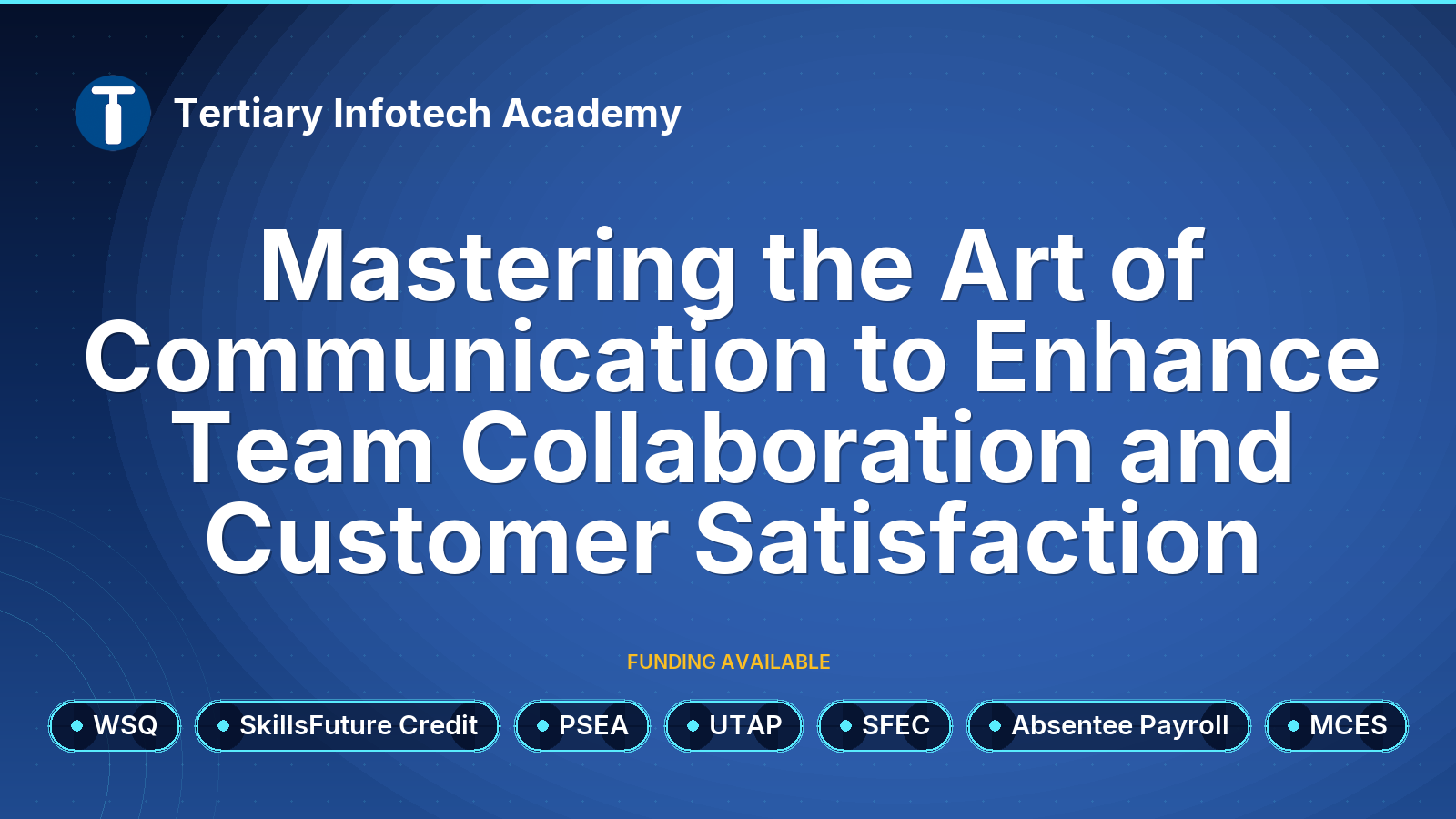
WSQ - Mastering the Art of Communication to Enhance Team Collaboration and Customer Satisfaction
$800.00 (GST-exclusive)
$872.00
(GST-inclusive)