You have no items in your shopping cart.

Blog / A Portrait Studio in Your Pocket: Inside Our 21 December 2025 Mobile Photography Outdoor Practical
A Portrait Studio in Your Pocket: Inside Our 21 December 2025 Mobile Photography Outdoor Practical
The fastest way to improve at photography is not a better camera or a longer lecture — it is walking out the door with a working professional and shooting real subjects in real light, with someone beside you who can say "move two steps left" at the exact moment it matters.
That is what the 21 December 2025 run of our CASL - Master Mobile Photography: Capturing Professional Photos with Your Smartphone course did. Led by Tan Chin Hock, a well-known Singapore photographer and educator, the class took their phones outdoors for the practical — and the photographs in this post, all shot on smartphones during that session, show what an afternoon of guided practice produces.
The classroom moves outside
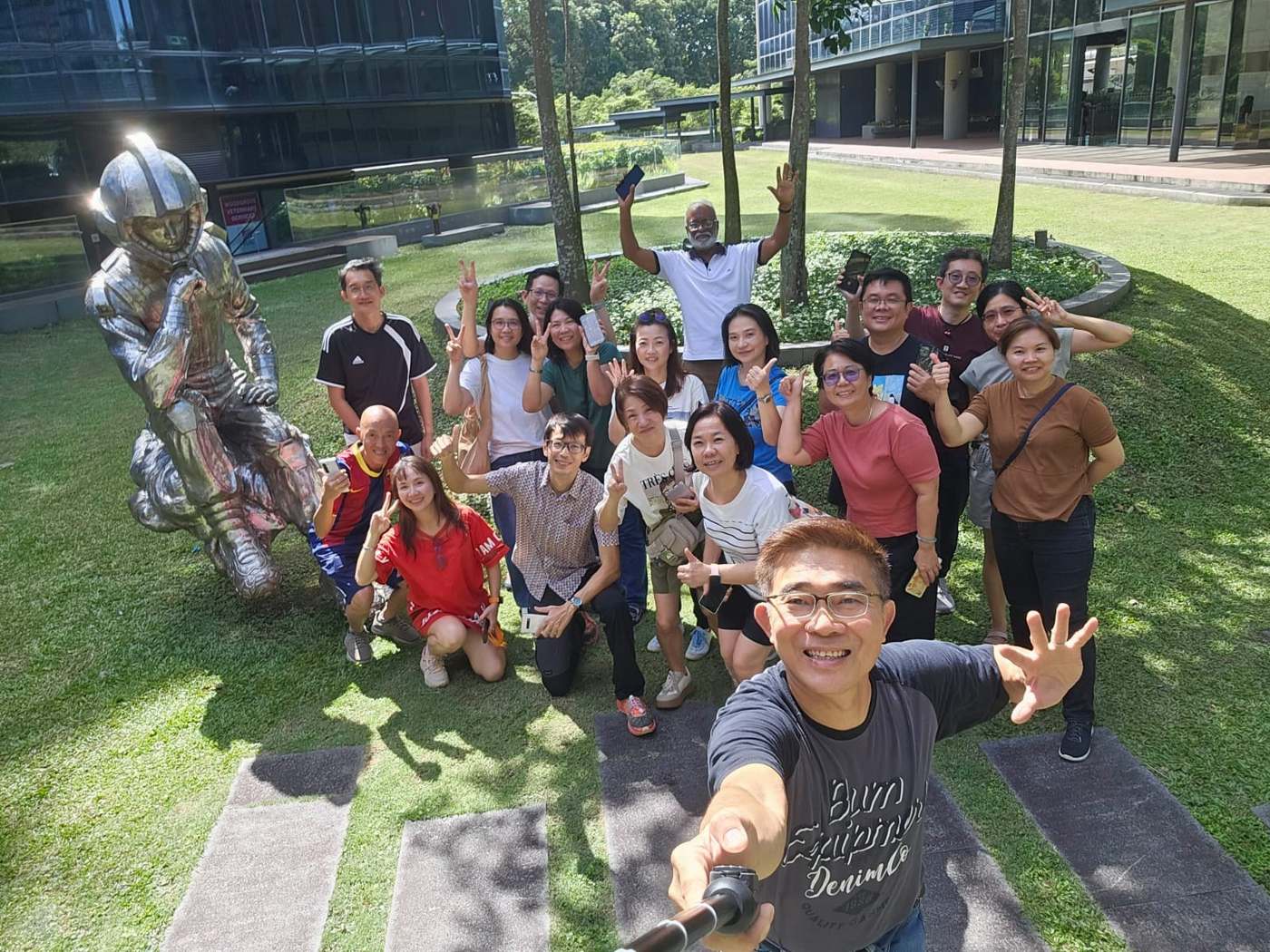
Even this group shot is a lesson. It is taken on a phone's ultra-wide lens at arm's length — and everything about it is deliberate. The group is arranged in two loose rows on rising ground so every face is visible. The midday sun comes from high behind the camera, lighting faces instead of silhouetting them. And the chrome astronaut sculpture anchors the left of the frame, giving the picture a landmark instead of a plain lawn.
Ultra-wide group selfies have two classic failure modes the class learns to manage: edge distortion (put people, not faces, near the frame edges) and the shrinking-heads effect of standing too far back. Get those right and one confident arm's-length frame beats a dozen "can someone take this for us" attempts.
Lesson 1: Shoot through something
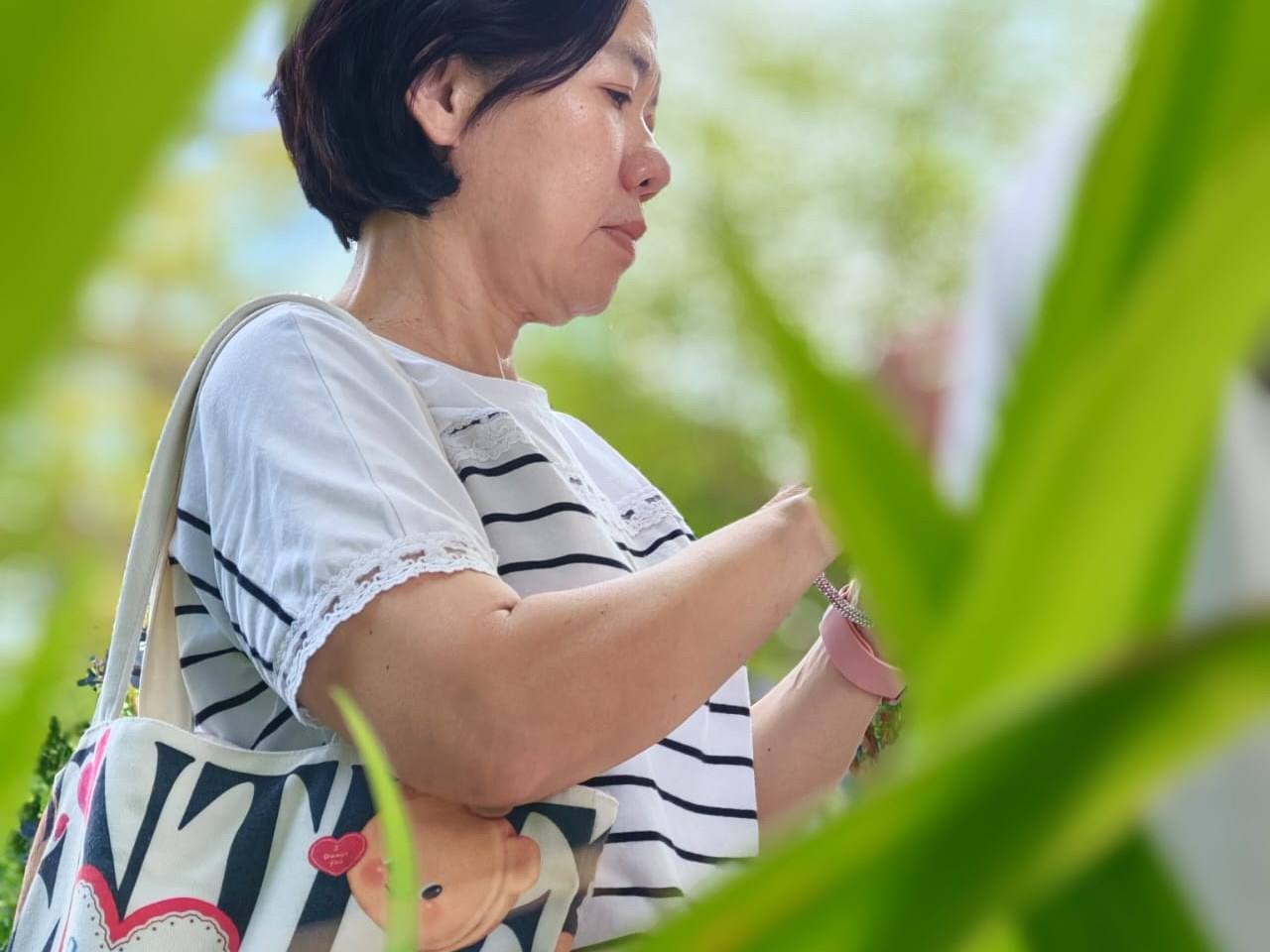
This candid portrait was not taken from a clear vantage point — and that is the point. The photographer deliberately shot through a plant, letting out-of-focus leaves sweep across the foreground. Because the lens is close to the leaves and focused past them on the subject, the foliage dissolves into soft green shapes that frame the face instead of hiding it.
The technique costs one tap: tap the subject's face so the phone locks focus and exposure there, and everything much nearer the lens falls apart into blur. It instantly adds depth, a sense of place, and the feeling that the viewer is glimpsing a real moment — which is why documentary and wedding photographers lean on it constantly. On the walk, learners practised finding these "peek-through" angles: leaves, railings, doorways, anything that can layer the foreground.
Lesson 2: Stability changes what your phone can do
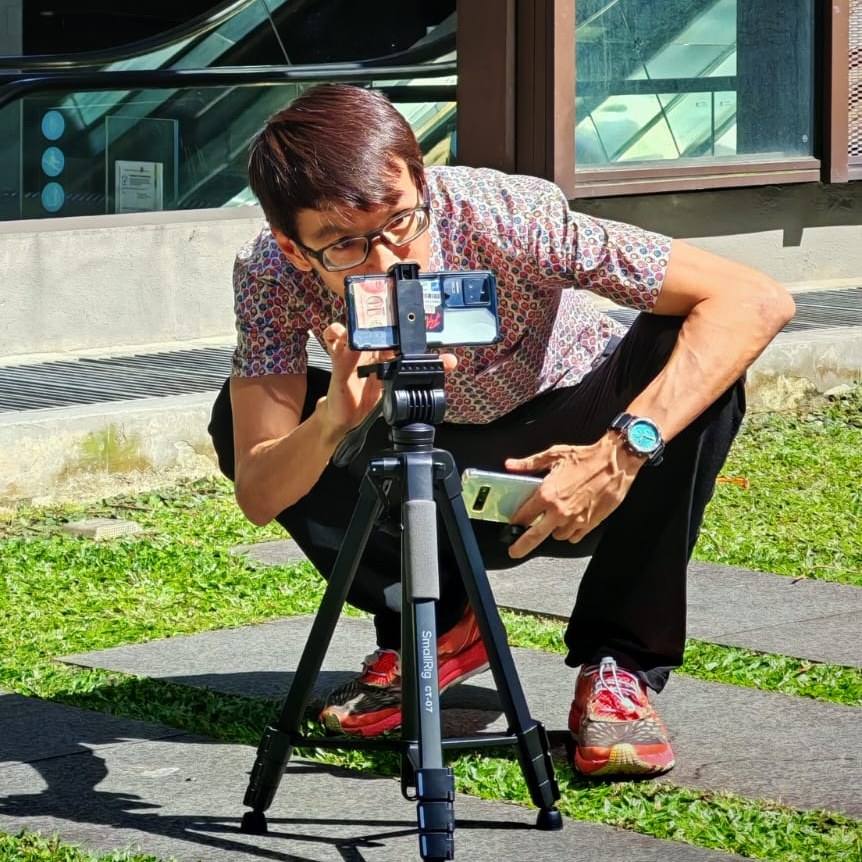
One learner working exactly the way we teach: phone clamped on a compact tripod, body dropped to the phone's level, second device in hand for reference. A tripod is usually seen as night-mode equipment, but its bigger gift is discipline — a fixed frame forces you to compose deliberately, check the edges, and wait for the moment, instead of spraying handheld frames and hoping.
The low angle matters too. Phone photos taken from standing eye height all look the same because everyone shoots from there. Drop the camera to waist or knee height and ordinary subjects — a path, a pet, a child, a puddle reflection — become graphic and unfamiliar. Add the shutter timer or a volume-button release and nothing touches the phone when the exposure fires.
Lesson 3: Separate your subject from the background
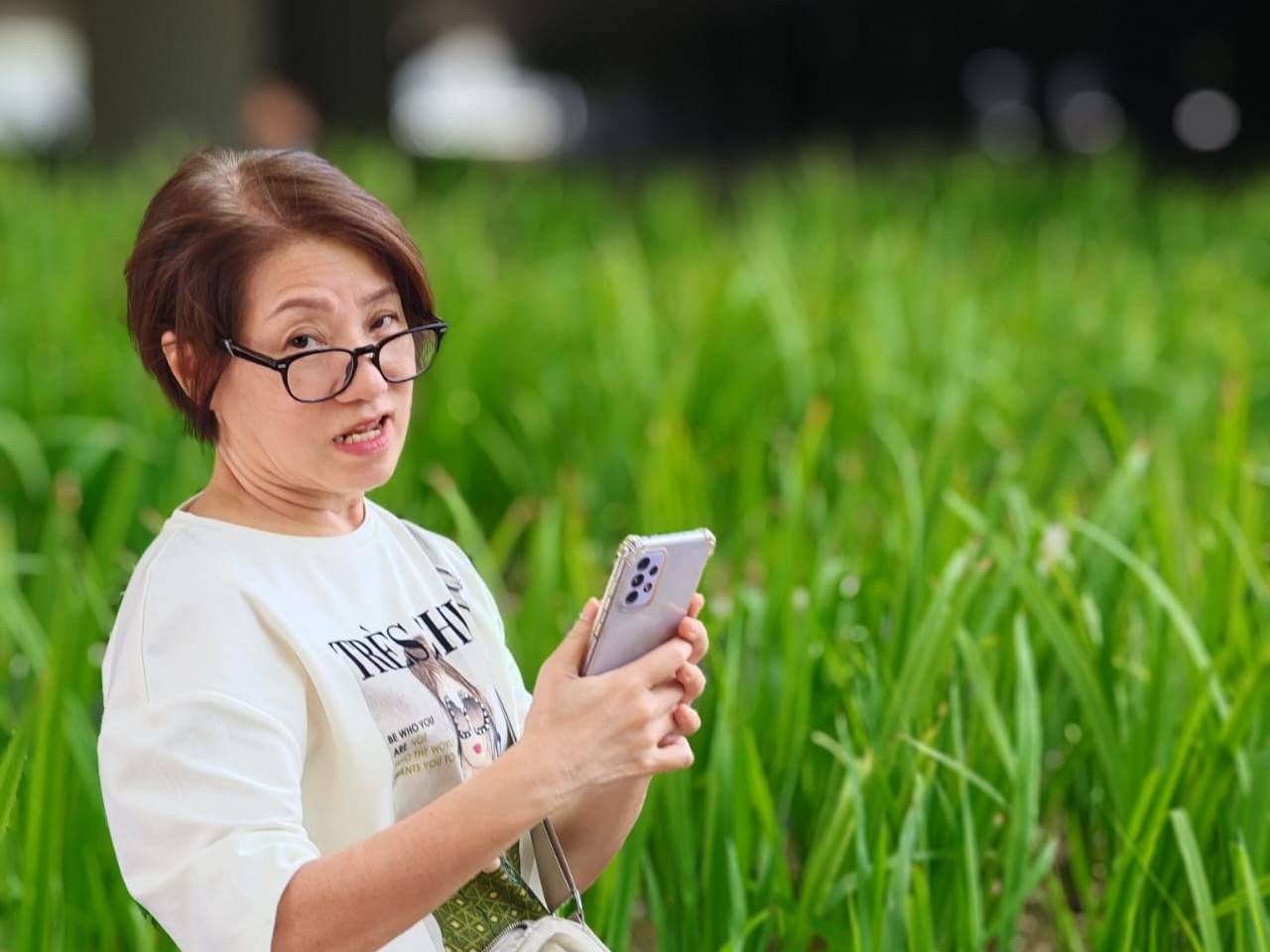
The third habit of the afternoon: choose the background first. This frame works because the photographer put the subject in front of a bed of tall greenery and let it fall out of focus into an even, saturated wash — a found studio backdrop, free, three steps off the walkway. The dark sheltered area above reads as a natural vignette.
Phones give you two routes to this separation: get physically close with the main lens, or step back and use the telephoto — both shrink depth of field optically — and portrait mode can add computational blur when the light or distance will not cooperate. The class covers when each route works and, just as usefully, when portrait mode's edge detection will fail (wisps of hair, glasses, gaps between fingers) and betray the effect.
What the practical actually builds
Four frames, four transferable habits:
- Direct the shot — arrange people, mind the sun, use a landmark; a group photo is composed, not collected.
- Layer the foreground — shoot through leaves, rails and frames; tap the subject and let the near layer blur.
- Stabilise and slow down — a tripod or a braced phone plus a considered frame beats twenty hopeful handheld frames.
- Pick backgrounds deliberately — hunt clean, distant, evenly-toned backdrops and let optics or portrait mode melt them.
Back in the classroom, the day rounds out with framing and composition theory, lighting, and editing — using popular mobile apps to carry a well-captured file to a polished, professional finish.
The course behind the session
CASL - Master Mobile Photography: Capturing Professional Photos with Your Smartphone (course code TGS-2026064718) is a 2-day, 16-hour course at Beginner level with a 2-hour assessment, held at our Woods Square campus, 12 Woodlands Square, Tower 1 — five minutes' walk from Woodlands MRT — and also available as synchronous online training over Zoom.
What it costs
The full fee is $720 before GST. With CASL funding:
| Who you are | Nett fee | Funding |
|---|---|---|
| Singapore Citizen / PR, aged 21 and above | $424.80 | 50% course-fee funding |
| Singapore Citizen aged 40 and above (MCES), or SME-sponsored | $280.80 | 70% course-fee funding |
GST of $64.80 (9%) applies to the full course fee. Eligible Singapore Citizens can apply SkillsFuture Credit and PSEA against the nett fee, NTUC members may claim UTAP, and employers can tap SFEC with Absentee Payroll support — check the course page for the current funding validity window. Completing the course earns a Certificate of Achievement from Tertiary Infotech Academy.
Check the next class date and funding eligibility →
Frequently asked questions
Does the class really shoot outdoors?
Yes. The course pairs classroom theory with practical exercises in real settings — the photographs in this post all come from the 21 December 2025 outdoor practical. Real light, real subjects and an instructor beside you is where the habits actually form.
Do I need to buy a tripod or accessories?
No. Every core technique works with just your phone. A compact phone tripod is an inexpensive optional extra that helps with low-angle work, long exposures and self-portraits — you will see one in action during the class and can decide afterwards whether it suits how you shoot.
My phone is a few years old. Will the techniques still work?
Yes. Composition, subject separation, foreground framing and stability are optics and judgement, not flagship features. Portrait mode and telephoto lenses extend what is possible, but the lessons that most improve your photographs work on any recent smartphone camera.
Is portrait mode cheating?
No — it is a tool, and the class teaches both the optical routes to background blur (get close, or use the telephoto) and the computational one, including the edge cases where portrait mode's cut-out fails so you know when to trust it and when to move your feet instead.
Is the course funded?
Yes. CASL funding brings the fee down to $424.80 nett for Singapore Citizens and PRs aged 21 and above, and $280.80 nett for Singapore Citizens aged 40 and above (MCES) or SME-sponsored staff. SkillsFuture Credit, PSEA, UTAP, SFEC and Absentee Payroll support apply — see the course page for details and the current validity window.
Where to go next
Every frame above came out of the camera its photographer already owned. What changed in one afternoon was the seeing — and that is trainable.
- This week, shoot one portrait through a foreground layer — leaves, a railing, a doorway. Tap the face, let the layer blur, compare it with a straight-on version.
- Join the next CASL - Master Mobile Photography run with Tan Chin Hock — from $280.80 nett for eligible Singapore Citizens aged 40 and above.
- Read the companion post from the 28 December 2025 run — five night-photography lessons, from leading lines to shooting craters on the moon.