You have no items in your shopping cart.
WSQ AI Vibe Coding Courses
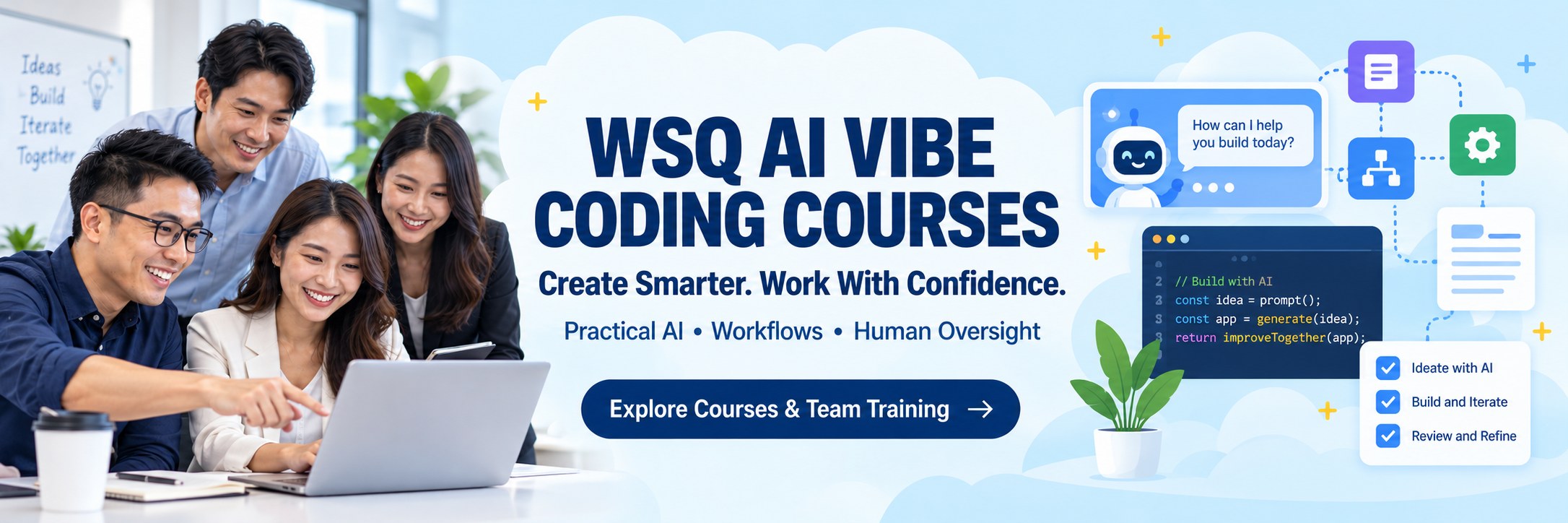
Your next professional breakthrough can begin with one skill you can put to work. Explore WSQ AI Vibe Coding Courses at Tertiary Courses Singapore and move beyond experimentation and use AI more purposefully to support real work and creative problem solving. Designed for professionals, creators, developers and teams turning AI interest into practical capability, this collection gives you a starting point for choosing training around the work you actually want to do. Make your goal specific: a better deliverable, a clearer decision or a task you can handle with greater confidence.
Start your shortlist with the courses listed here, including AI for Shopify eCommerce Store and Build Professional Web Apps Quickly with AI-Assisted Vibe Coding. Use these options to explore task design, effective instructions, workflow integration, output evaluation and human oversight, then compare the individual outlines to find the right scope and level. You do not need to master every topic at once. Choose one priority, build a sound foundation and extend your learning when you are ready for the next challenge.
Give your learning plan a head start: write down one repetitive or creative task, non-sensitive example inputs and a clear standard for a useful result. Bring that brief to your course selection or enquiry so the discussion can focus on a useful outcome. Consider how you will practise afterwards, what a good result looks like and who should review it. For teams, align the learning goal with a shared workflow and agree how colleagues will apply the new skills together.
Ready to take the next step? Browse the course outlines, check prerequisites, schedules and fees, and shortlist the training that fits your goals. Contact our team with your role, current experience and preferred outcome for help choosing a course or discussing a team training enquiry. Discuss your training goals on WhatsApp. Start with one relevant capability and build a learning pathway you can act on. For WSQ-labelled options, check the individual course for current funding eligibility, learner conditions and applicable fees before registering.
-
WSQ - AI Vibe Coding for Machine Learning
- WSQ
- SFC
- PSEA
- SFEC
- Absentee Payroll
- MCES
This course equips participants with practical skills to use AI vibe coding and Python to build machine learning solutions using scikit-learn. Learners will use natural-language instructions and AI coding assistants to generate, explain, test, debug, and refine Python code, making machine learning development faster and more accessible. Participants will learn how to prepare data for machine learning by importing, cl....$750.00 (GST-exclusive)$817.50 (GST-inclusive)before funding and GST
-
WSQ - Create REST APIs with AI Vibe Coding
- WSQ
- SFC
- PSEA
- UTAP
- SFEC
- Absentee Payroll
- MCES
The WSQ Create REST APIs with AI Vibe Coding course equips learners with practical skills to design, build, test, and integrate REST APIs using modern AI-assisted coding techniques. Through hands-on activities, participants will use AI coding tools to accelerate development, generate code, troubleshoot errors, and refine API functionality while developing a strong understanding of REST API fundamentals.Learners will ....$700.00 (GST-exclusive)$763.00 (GST-inclusive)before funding and GST
-
WSQ - AI Vibe Coding with Rust
- WSQ
- SFC
- PSEA
- UTAP
- SFEC
- Absentee Payroll
- MCES
This WSQ AI Vibe Coding with Rust course equips learners with practical Rust programming skills while introducing AI-assisted development techniques to accelerate the coding process. Participants will learn the fundamentals of Rust, including variables, data types, functions, control structures, ownership, borrowing, error handling, and commonly used data structures, while using AI coding tools to generate, explain, ....$800.00 (GST-exclusive)$872.00 (GST-inclusive)before funding and GST
-
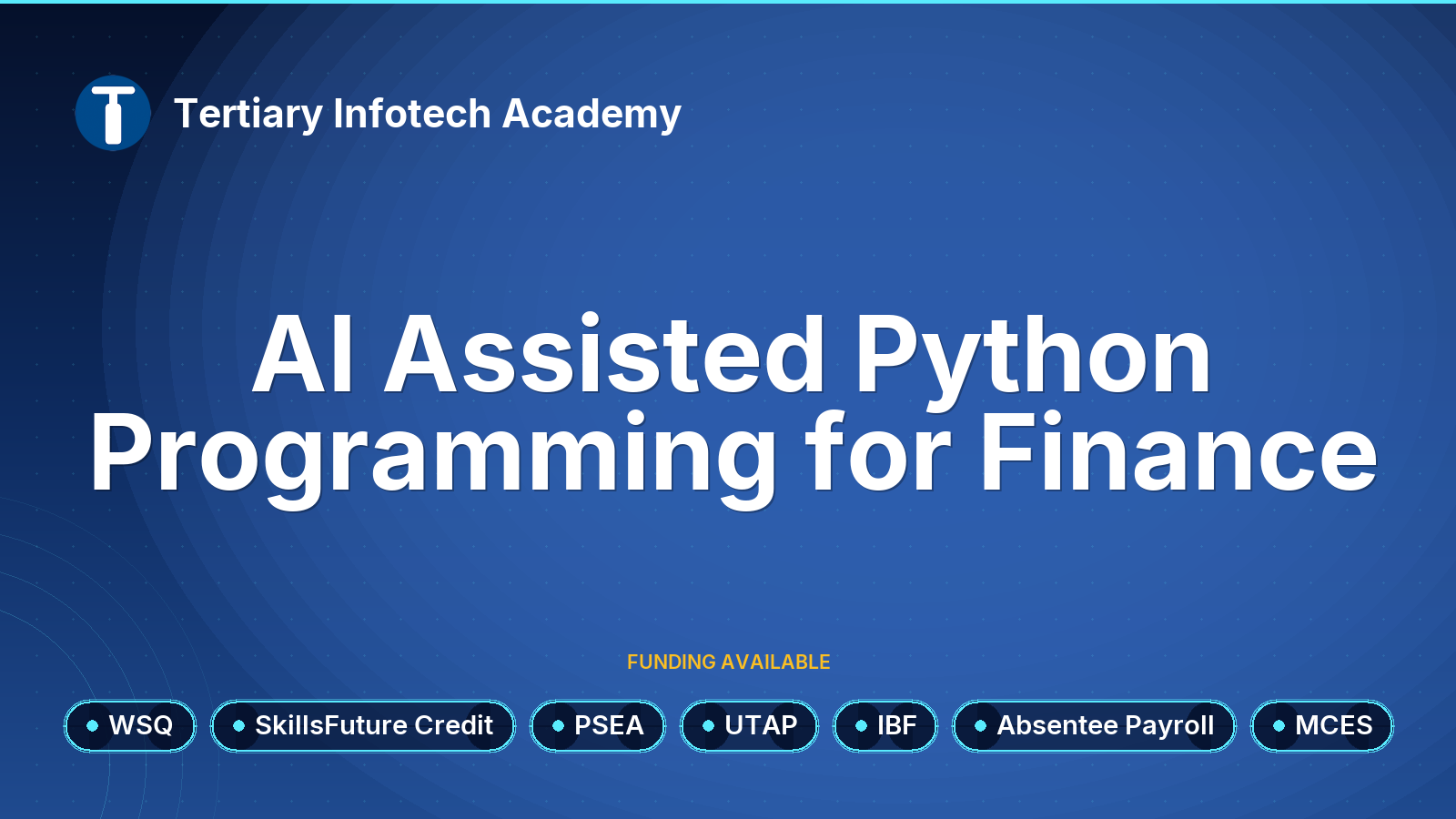
IBF - AI Assisted Python Programming for Finance
- WSQ
- SFC
- PSEA
- IBF
- Absentee Payroll
- MCES
This comprehensive course on Python Programming for Financial Services is designed from basic to advanced levels, targeting professionals looking to leverage Python for financial data analysis and software development within the finance sector. Participants will start with an introduction to Python programming, understanding its application in meeting business requirements, setting up Python IDEs, and diving deep int....$2,000.00 (GST-exclusive)$2,180.00 (GST-inclusive)before funding and GST