You have no items in your shopping cart.
Blog / A Wi-Fi Chip and a Room Full of Beginners: Our 7 April 2017 IoT Class
A Wi-Fi Chip and a Room Full of Beginners: Our 7 April 2017 IoT Class
On 7 April 2017, a class gathered at our old premise at Bukit Timah Shopping Centre to spend a day connecting things to the internet. The trainer was Mr Deepak, and the subject was one that in 2017 still needed explaining at dinner tables: the Internet of Things.
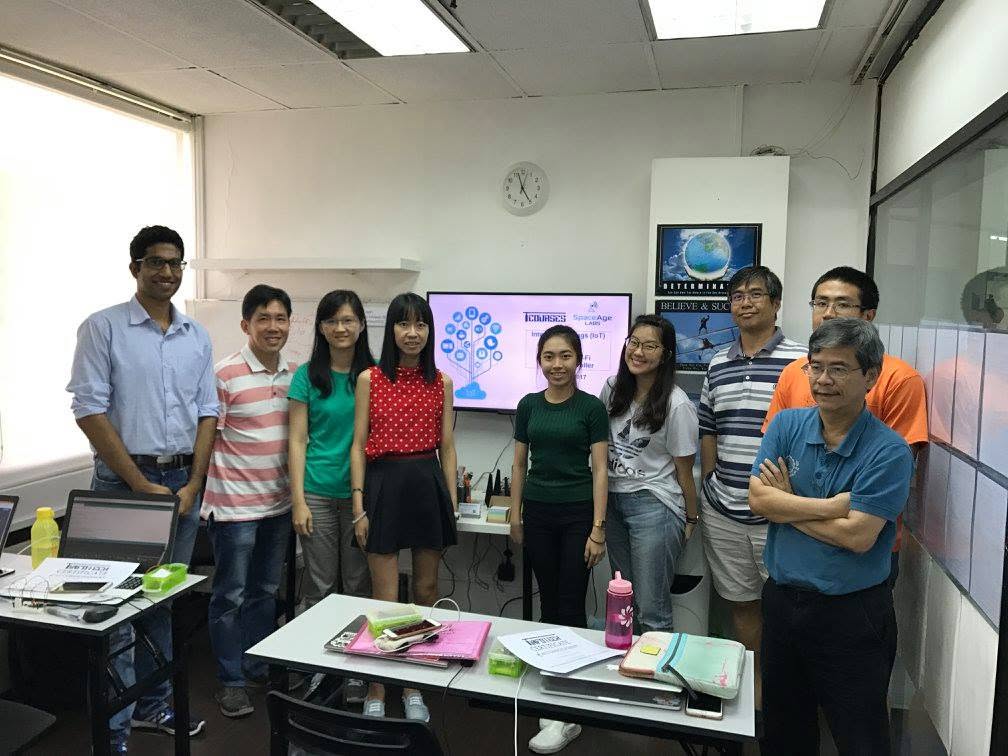
This is a look back at what learning IoT in Singapore looked like nearly a decade ago — before the course carried WSQ accreditation, before "smart nation" was daily vocabulary, and before the skills in that room became something the government would help pay for.
2017: when a $5 chip changed who could learn IoT
The reason a beginner class like this could exist at all was a piece of hardware: the ESP8266, a Wi-Fi microcontroller that cost a few dollars and could be programmed by anyone with a laptop and a USB cable. Before it, putting a sensor on the internet meant embedded-engineering budgets. After it, a beginner could read a temperature sensor and publish the value to a cloud dashboard in an afternoon.
That is exactly what a 2017 IoT class was: wire up a sensor, get the chip on the Wi-Fi, push readings to the cloud, and then — the part that always got the room excited — flip the direction and switch something on from a web page.
Here is the detail worth smiling at: open today's course outline and the ESP8266 is still there, under "Transmit Data using ESP8266". The platforms around it changed, the funding around it changed, the venue changed — the little Wi-Fi chip earned its place and kept it.
What the class did that day
The shape of the day in 2017 is the same shape the course has now, because it is the natural shape of the subject:
- Understand the moving parts. Sensors measure, actuators act, and a wireless link carries the data. Once you see IoT as those three pieces, every smart device stops being magic.
- Collect and post data to the cloud. Read a sensor with the microcontroller, then transmit the values over Wi-Fi so they land somewhere you can see them from anywhere.
- Control devices from the cloud. Reverse the flow: a value or a button on a dashboard reaches back through the internet and switches a real device.
- Make the data useful. A single reading is trivia; a chart of readings is information you can act on.
Everyone worked hands-on with the kit. That has never changed either — IoT is not a subject you can learn by watching someone else's wires.
What a decade changed — and what it did not
- The accreditation arrived. In 2017 this was a short course you simply signed up and paid for. The WSQ version, with funding support, arrived in 2020 — today the $750 course comes down to $442.50 or $292.50 nett for eligible Singaporeans.
- The stack matured. MQTT and REST APIs — the protocols the course teaches for posting and reading data — went from hobbyist choices to industry standards running smart buildings and factories.
- The premises changed. Bukit Timah Shopping Centre was home then; classes now run at Woods Square in Woodlands, five minutes from the MRT.
- The fundamentals did not move. Sensors, actuators, a wireless link, a cloud that stores and returns data. Everything Mr Deepak taught in that room is still the backbone of the subject.
The course today
WSQ - Internet of Things (IoT) Fundamental for Beginners (course code TGS-2020504020) is a 2-day, 16-hour course at Beginner level with a 2-hour assessment, held at Woods Square Tower 1, Woodlands. It maps to the SkillsFuture Skills Framework TSC Internet of Things Application (PTP-TEM-3002-1.1), with three learning outcomes:
- Understand the uses and functions of IoT technologies
- Post sensor data to cloud for IoT review
- Control devices from cloud data sources
The two days cover IoT sensors and actuators, wireless communication technologies, cloud computing for IoT, collecting and posting sensor data with the ESP8266 over MQTT or REST API, remote device control, and IoT data analytics, visualization and security. An IoT kit is used throughout the training (the kit itself is not included in the course fee).
What it costs
The full fee is $750 before GST. With WSQ funding:
| Who you are | Nett fee | Funding |
|---|---|---|
| Singapore Citizen / PR, aged 21 and above | $442.50 | 50% course-fee funding |
| Singapore Citizen aged 40 and above (MCES), or SME-sponsored | $292.50 | 70% course-fee funding |
GST of $67.50 (9%) applies to the full course fee. Funding is valid from 20 May 2020 to 19 May 2028. Eligible Singapore Citizens can apply SkillsFuture Credit and PSEA against the nett fee, NTUC members may claim UTAP, and employers can tap SFEC with Absentee Payroll support. Completion — at least 75% attendance plus a pass in the assessment — earns a Certificate of Achievement from Tertiary Infotech Academy and an OpenCert (Statement of Achievement) from SkillsFuture Singapore.
Check the next class date and funding eligibility →
Frequently asked questions
Is the course still hands-on like the 2017 class?
Yes. An IoT kit is used throughout the training — you wire sensors, transmit real data over Wi-Fi and control real devices from the cloud, rather than watching a demonstration. Note the course fee does not include the kit itself.
Do I need a programming or electronics background?
No. The course is at Beginner level — the entry requirement is basic computer literacy and the ability to operate a laptop. The 2017 class was full of first-timers, and that is still who the course is designed for.
What is the ESP8266 and why does it still matter?
A low-cost Wi-Fi microcontroller that made IoT accessible to beginners when it appeared in the mid-2010s. It is still on the course outline because it remains one of the cheapest, clearest ways to learn the pattern every IoT system uses: sense, transmit, store, act.
Was the 2017 class WSQ funded?
No. WSQ funding for this course began on 20 May 2020. In 2017 learners paid the full fee — today, eligible Singapore Citizens aged 40 and above or SME-sponsored staff pay $292.50 nett for the same fundamentals, taught over two full days.
Where is the class held now?
At 12 Woodlands Square, #07-85/86/87 Woods Square Tower 1, Singapore 737715 — a five-minute walk from Woodlands MRT (NS9). The venue is disabled-friendly. The Bukit Timah Shopping Centre premises in the photograph are from our early years.
Where to go next
Nearly a decade on, the subject that needed explaining in 2017 now runs your building's aircon, your carpark's sensors and a good part of Singapore's smart-nation infrastructure. The way in has not changed: one chip, one sensor, one afternoon.
- Join the next WSQ - Internet of Things (IoT) Fundamental for Beginners class — from $292.50 nett for eligible Singapore Citizens aged 40 and above.
- Then see how far the fundamentals stretch: we built our own self-hosted IoT platform with a Python SDK on exactly the sense-transmit-store-act pattern taught in class.